| People | Miꞌkmaq |
|---|---|
| Province | Nova Scotia |
| Land[1] | |
| Main reserve | Eskasoni 3 |
| Other reserve(s) | |
| Land area | 42.809 km2 |
| Population (2021)[2] | |
| On reserve | 3973 |
| Off reserve | 700 |
| Total population | 4673 |
| Government[3] | |
| Chief | Leroy Denny |
| Council size | 12 |
| Tribal Council[4] | |
| Union of Nova Scotia Miꞌkmaq | |
| Website | |
| eskasoni.ca | |
The Eskasoni Mi'kmaw Nation (Miꞌkmaq: Eskissonqnik) is a band government of the Mi'kmaq First Nations, located in Unama'ki (Cape Breton), Nova Scotia, Canada. As of 2021, Eskasoni has a membership of 4,675. Of this population, 3,973 live on-Reserve, and 667 live off-Reserve.[5]
History
| Year | Pop. | ±% |
|---|---|---|
| 1871 | 125 | — |
| 1891 | 80 | −36.0% |
| 1900 | 140 | +75.0% |
| 1941 | 200 | +42.9% |
| 1991 | 2,206 | +1003.0% |
| 2001 | 2,741 | +24.3% |
| 2023 | 5,064 | +84.8% |
| Source: Statistics Canada,[6][7] | ||
The word 'Eskasoni' is derived from the Mi'kmaq word We'kwistoqnik, which means 'where the fir trees are plentiful'.[8]
In 1942, the federal government enacted a centralization policy through Indian Affairs. This policy led to the forced relocation of hundreds of Mi’kmaq from to two reserves – Eskasoni and Shubenacadie, known today as Sipekne’katik.[9] This led to rapid population growth in Eskasoni, which was previously home to less than 200 residents.
In 2016 Dr. Mohan Singh Virick, a Sikh doctor who served Eskasoni for 50 years, donated 140 hectares (335 acres) of land.[10] He also donated a building in Sydney to help house Eskasoni's growing population.[11]
Present day
Eskasoni is the most populous community of the Mi'kmaq Nation. It has its own community radio station, CICU-FM, broadcasting at 94.1 MHz. The Eskasoni First Nation is also home of the Unama'ki Institute of Natural Resources, a Mi'kmaq organization devoted to natural resources and the environment.
The community operates its own school board, providing services to children from kindergarten to grade 12.[12]
The Eskasoni First Nation is composed of three parts:
| Community | Area | Location | Population | Date established |
|---|---|---|---|---|
| Eskasoni 3 | 3,504.6 hectares (8,660 acres) | 40 km. southwest of Sydney | 3,973 | July 1, 1832 |
| Eskasoni 3A | 28.5 hectares (70 acres) | 40 km. southwest of Sydney | 0 | July 20, 1948 |
| Malagawatch 4 (1/5 share) | 661.3 hectares (1,634 acres) | 62 km. southwest of Sydney | 0 | August 2, 1833 |
References
- ↑ "First Nation Detail". Crown–Indigenous Relations and Northern Affairs Canada. Government of Canada. Retrieved December 28, 2019.
- ↑ "First Nation Detail". Crown–Indigenous Relations and Northern Affairs Canada. Government of Canada. Retrieved December 28, 2019.
- ↑ "First Nation Detail". Crown–Indigenous Relations and Northern Affairs Canada. Government of Canada. Retrieved December 28, 2019.
- ↑ "First Nation Detail". Crown–Indigenous Relations and Northern Affairs Canada. Government of Canada. Retrieved December 28, 2019.
- ↑ Branch, Government of Canada; Indigenous and Northern Affairs Canada; Communications (November 3, 2008). "Home". Crown–Indigenous Relations and Northern Affairs Canada. Government of Canada. Retrieved March 17, 2021.
{{cite web}}: CS1 maint: multiple names: authors list (link) - ↑ "No need of a chief for this band" (PDF). UBC Press. Retrieved March 17, 2021.
- ↑ Government of Canada (January 15, 2008). "2006 Aboriginal Population Profile". www12.statcan.gc.ca. Statistics Canada. Retrieved March 17, 2021.
- ↑ "Eskasoni First Nation" (PDF). Dalhousie University. Retrieved March 17, 2021.
- ↑ Roache, Trina (April 10, 2020). "Uprooted: The little known story about Mi'kmaw history of forced relocation". APTN News. Retrieved March 17, 2021.
- ↑ Network, SaltWire. "Cape Breton doctor to be honoured". Cape Breton Post.
- ↑ "Respected physician says First Nation needs the land 'more than I do'". www.mmnn.ca. Mi’kmaq-Maliseet Nations News. Retrieved March 17, 2021.
- ↑ "History of Eskasoni". www.eskasoni.ca. Retrieved March 17, 2021.
External links
- Eskasoni Band Council
- Collections Canada "Virtual Tour" of the Eskasoni First Nation community
- Eskasoni Fish & Wildlife Commission
- Government of Canada's Department of Aboriginal Affairs and Northern Development Canada Eskasoni First Nation profile
- Unama'ki Institute of Natural Resources
| Regional municipalities | 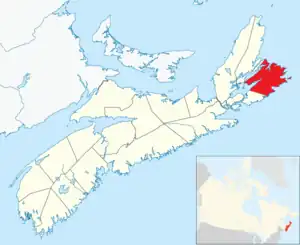 | |
|---|---|---|
| First Nations | ||
| Indian reserves | ||
| Former municipalities | ||
| ||