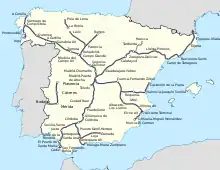
 | |
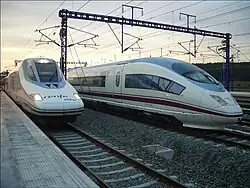 | |
| Main station(s) | Madrid Atocha, Barcelona Sants, Seville-Santa Justa, Zaragoza–Delicias |
|---|---|
| Other station(s) | Madrid Chamartín, Valencia-Joaquín Sorolla, Málaga-María Zambrano, Granada, Alicante Terminal, Valladolid-Campo Grande, A Coruña-San Cristóbal, Santiago de Compostela railway station, Ourense, Córdoba |
| Fleet size | 24 S-100 16 S-102 26 S-103 30 S-112 |
| Stations called at | 30 |
| Parent company | Renfe |
| Technical | |
| Track gauge | Standard (1435 mm) |
| Previous gauge | Iberian (1668 mm) |
| Electrification | 25 kV AC (some sections on 3 kV DC network) |
| Length | 3,966 km (2,464 mi)[1] |
| Other | |
| Website | https://www.renfe.com |
Alta Velocidad Española (AVE)[lower-alpha 1] is a high-speed rail service operated by Renfe, the Spanish State railway company.
The first AVE service was inaugurated in 1992, with the introduction of the first Spanish high-speed railway connecting the cities of Madrid, Córdoba and Seville.
In addition to Renfe's use of the Administrador de Infraestructuras Ferroviarias-managed rail infrastructure in Spain, Renfe offers two AVE services partially in France, connecting respectively Barcelona-Lyon and Madrid-Marseille.[2]
Alta Velocidad Española translates to "Spanish High Speed", but the initials are also a play on the word ave, meaning "bird". AVE trains operate at speeds of up to 300 km/h (186 mph).[3][4]
Services
As of 2023 Renfe offers the following AVE services:[5]
- Alicante–León via Albacete, Cuenca, Madrid Chamartín, Valladolid and Palencia.
- Alicante–Ourense via Albacete, Cuenca, Madrid Chamartín and Zamora.
- Barcelona–Granada via Tarragona, Lleida, Zaragoza, Ciudad Real, Puertollano, Córdoba and Antequera.
- Barcelona–Málaga via Tarragona, Lleida, Zaragoza, Ciudad Real, Córdoba, Puente Genil-Herrera, and Antequera.
- Barcelona–Seville via Tarragona, Lleida, Zaragoza, Ciudad Real, Puertollano and Córdoba (trains with selective stops are also scheduled).
- Madrid–Alicante via Cuenca, Albacete, and Villena (non stop trains and trains with selective stops are also scheduled).
- Madrid–Barcelona via Guadalajara, Calatayud, Zaragoza, Lleida, and Tarragona (non stop trains and trains with selective stops are also scheduled).
- Madrid–Castellón via Cuenca, Requena-Utiel and Valencia.
- Madrid–Figueres via Guadalajara, Calatayud, Zaragoza, Lleida, Tarragona, Barcelona and Girona (trains are scheduled with selective stops).
- Madrid–Granada via Ciudad Real, Puertollano, Córdoba, Puente Genil-Herrera, Antequera and Loja (trains with selective stops are also scheduled).
- Madrid–Huesca via Guadalajara, Calatayud, Zaragoza, and Tardienta.
- Madrid–León via Segovia, Valladolid and Palencia.
- Madrid–Málaga via Ciudad Real, Puertollano, Córdoba, Puente Genil-Herrera, and Antequera (non stop trains and trains with selective stops are also scheduled).
- Madrid–Murcia via Elche and Orihuela (some trains are arriving to Alicante and then reversing towards Murcia).
- Madrid–Ourense via Zamora.
- Madrid–Seville via Ciudad Real, Puertollano, and Córdoba (non stop trains and trains with selective stops are also scheduled).
- Madrid–Valencia via Cuenca and Requena-Utiel (non stop trains are also scheduled).
- Valencia–Seville via Cuenca, Ciudad Real, Puertollano, and Córdoba.
- Valencia–Burgos via Requena-Utiel, Cuenca, Madrid Chamartín and Valladolid (trains with selective stops are also scheduled).
- International:[6]
- Barcelona–Lyon via Girona, Figueres, Perpignan, Narbonne, Montpellier, Nîmes, and Valence.
- Madrid–Marseille via Guadalajara, Zaragoza, Tarragona, Barcelona, Girona, Figueres, Perpignan, Narbonne, Béziers, Montpellier, Nîmes, Avignon and Aix-en-Provence.
The central hub of the AVE system is Madrid's Puerta de Atocha, except for the Madrid–León, Madrid–Burgos, Madrid–Galicia, Madrid–Alicante and Madrid-Murcia lines, that terminate at Chamartín station.[7][8]
Trains
Currently, there are several series of high-speed trains that run the AVE service:
- S/100, manufactured by Alstom
- S/102, manufactured by Talgo and Bombardier
- S/103, manufactured by Siemens, marketed globally under the brand Siemens Velaro
- S/112, manufactured by Talgo and Bombardier
 A Talgo 350 train (Renfe Class 102) at Madrid Atocha station.
 AVE train Talgo 350 (Renfe Class 102)
 Talgo 350 train (Renfe Class 102) at Lleida Pirineus station
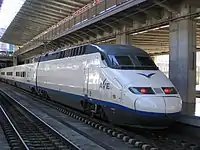 AVE "Alstom" (Renfe Class 100) trainset at Córdoba.
 A RENFE AVE S/103 (Siemens Velaro E) at Figueres Vilafant railway station in 2013.
Passenger usage
The still-growing network transported a record 21.3 million passengers in 2018.[9] Though the network length is extensive, it lags in ridership behind comparable high-speed rail systems in Japan, France, Germany, China, Taiwan, and Korea.
| 2006 | 2007 | 2008 | 2009 | ||||||
|---|---|---|---|---|---|---|---|---|---|
| 4.878 | 5.559 | 11.461 | 11.250 | ||||||
| 2010 | 2011 | 2012 | 2013 | 2014 | 2015 | 2016 | 2017 | 2018 | 2019 |
| 10.851 | 12.563 | 12.101 | 14.697 | 17.967 | 19.428 | 20.352 | 21.108 | 21.332 | 22.370 |
| 2020 | 2021 | 2022 | 2023 | 2024 | 2025 | 2026 | 2027 | 2028 | 2029 |
| 7.603 | 12,282 | 23,562 |
Rail infrastructure in Spain and Europe
Notes
- ↑ Spanish pronunciation:
- [ˈalta βeloθiˈðað espaˈɲola], [ˈaβe]
References
- ↑ "Red de Alta Velocidad". ADIF. Retrieved 7 May 2023.
- ↑ "Renfe empieza a operar en Francia con un AVE entre Barcelona y Lyon". rtve.es. 13 July 2023.
- ↑ "Madrid — Barcelona at 310 km/h with ETCS Level 2". Railway Gazette International. London. 18 October 2011. Retrieved 9 November 2011.
- ↑ "Velocidades máximas de los trenes y de las líneas" (maximum speeds of the trains and of the lines), last updated on 10 December 2022, accessed on 7 May 2023.
- ↑ "Renfe". Renfe. Retrieved 7 May 2023.
- ↑ "Renfe places AVE (high-speed) tickets on sale in France". Renfe. 21 June 2023. Retrieved 21 August 2023.
- ↑ "Renfe reorganiza la oferta de los servicios AVE Madrid-Alicante tras el traslado de la cabecera de Puerta de Atocha a Chamartín Clara Campoamor" (in Spanish). Renfe. 19 August 2022. Retrieved 23 August 2022.
- ↑ "El AVE Madrid-Murcia comenzará el servicio comercial el próximo 20 de diciembre". Renfe. 12 December 2022. Retrieved 20 December 2022.
- ↑ "El AVE suma su sexto récord anual al cerrar 2018 con 21,3 millones de viajeros, un 3,7%". Europa Press (in Spanish). 8 February 2019. Retrieved 29 August 2019.
- ↑ Railway Gazette International, https://www.railwaygazette.com/in-depth/high-speed-open-access-comes-to-spain/56641.article
- ↑ "Spain: high-speed rail passenger traffic 2022". Statista. Retrieved 2023-12-24.
External links

| |||||||||||||||||||