 | |
 | |
| Clinical data | |
|---|---|
| Trade names | Betimol, Blocadren, Istalol, Timoptic, others[1] |
| AHFS/Drugs.com | Maleate Monograph eent Monograph |
| MedlinePlus | a684029 |
| License data | |
| Pregnancy category |
|
| Routes of administration | By mouth, topical (eye drop) |
| Drug class | Beta blocker |
| ATC code | |
| Legal status | |
| Legal status | |
| Pharmacokinetic data | |
| Bioavailability | 60% |
| Metabolism | Liver (80%, mainly CYP2D6[2]) |
| Onset of action | 15–30 min[3] |
| Elimination half-life | 2.5–5 hours |
| Duration of action | 24 hours[3] |
| Excretion | Kidney |
| Identifiers | |
| |
| CAS Number | |
| PubChem CID | |
| IUPHAR/BPS | |
| DrugBank | |
| ChemSpider | |
| UNII | |
| KEGG | |
| ChEBI | |
| ChEMBL | |
| CompTox Dashboard (EPA) | |
| ECHA InfoCard | 100.043.651 |
| Chemical and physical data | |
| Formula | C13H24N4O3S |
| Molar mass | 316.42 g·mol−1 |
| 3D model (JSmol) | |
| |
| |
| (verify) | |

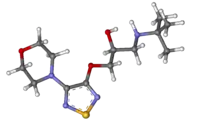
Timolol is a beta blocker medication used either by mouth or as eye drops.[3][4] As eye drops it is used to treat increased pressure inside the eye such as in ocular hypertension and glaucoma.[3] By mouth it is used for high blood pressure, chest pain due to insufficient blood flow to the heart, to prevent further complications after a heart attack, and to prevent migraines.[4]
Common side effects with the drops is irritation of the eye.[3] Common side effects by mouth include tiredness, slow heart beat, itchiness, and shortness of breath.[4] Other side effects include masking the symptoms of low blood sugar in those with diabetes.[3] Use is not recommended in those with asthma, uncompensated heart failure, or COPD.[3] It is unclear if use during pregnancy is safe for the baby.[5] Timolol is a non-selective beta blocker.[3]
Timolol was patented in 1968, and came into medical use in 1978.[6] It is on the World Health Organization's List of Essential Medicines.[7] Timolol is available as a generic medication.[3][8] In 2020, it was the 143rd most commonly prescribed medication in the United States, with more than 4 million prescriptions.[9][10]
Medical uses
By mouth
In its by mouth or oral form, it is used:
- to treat high blood pressure
- to prevent heart attacks
- to prevent migraine headaches[11]
The combination of timolol and the alpha-1 blocker prazosin has sedative effects.[12]
Eye drops
In its eye drop form it is used to treat open-angle and, occasionally, secondary glaucoma.[3][13] The mechanism of action of timolol is probably the reduction of the formation of aqueous humor[3] in the ciliary body in the eye. It was the first beta blocker approved for topical use in treatment of glaucoma in the United States (1978).[14] When used by itself, it depresses intraocular pressure (IOP) 18–34% below baseline within first few treatments. However, there are short-term escape and long-term drift effects in some people. That is, tolerance develops. It may reduce the extent of the daytime IOP curve up to 50%. The IOP is higher during sleep. Efficacy of timolol in lowering IOP during the sleep period may be limited.[15][16][17] It is a 5–10× more potent beta blocker than propranolol. Timolol is light-sensitive; it is usually preserved with 0.01% benzalkonium chloride (BAC), but also comes BAC-free. It can also be used in combination with pilocarpine, carbonic anhydrase inhibitors[18] or prostaglandin analogs.[19]
A Cochrane review compared the effect of timolol versus brimonidine in slowing the progression of open angle glaucoma in adults but found insufficient evidence to come to conclusions.[20]
On the skin
In its gel form it is used on the skin to treat infantile hemangiomas.[21]
Contraindications
The medication should not be taken by individuals with:[22]
- An allergy to timolol or any other beta-blockers
- Asthma or severe chronic obstructive bronchitis
- A slow heart rate (bradycardia), or a heart block
- Heart failure[23]
Side effects
The most serious possible side effects include cardiac arrhythmias and severe bronchospasms.[22] Timolol can also lead to fainting, congestive heart failure, depression, confusion, worsening of Raynaud's syndrome and impotence.[22]
Side effects when given in the eye include: burning sensation, eye redness, superficial punctate keratopathy, corneal numbness.[24][13]
Formulations
It is available in tablet and liquid formulations.[22][24]
For ophthalmic use, timolol is also available combined:
- with carbonic anhydrase inhibitors:
- timolol and brinzolamide
- timolol and dorzolamide
- with α2 agonists:
- with prostaglandin analogs:
- timolol and latanoprost
- timolol and travoprost
Brand names
Timolol is marketed under many trade names worldwide.[1] Timolol eye drops are marketed under the brand name Istalol among others.[25][26]
References
- 1 2 "Timolol". Drugs.com. Archived from the original on 7 March 2016. Retrieved 28 December 2016.
- ↑ Volotinen M, Turpeinen M, Tolonen A, Uusitalo J, Mäenpää J, Pelkonen O (July 2007). "Timolol metabolism in human liver microsomes is mediated principally by CYP2D6". Drug Metabolism and Disposition. 35 (7): 1135–1141. doi:10.1124/dmd.106.012906. PMID 17431033. S2CID 794764.
- 1 2 3 4 5 6 7 8 9 10 11 "Timolol eent". The American Society of Health-System Pharmacists. Archived from the original on 28 December 2016. Retrieved 8 December 2016.
- 1 2 3 "Timolol Maleate". The American Society of Health-System Pharmacists. Archived from the original on 28 December 2016. Retrieved 8 December 2016.
- ↑ "Timolol ophthalmic Use During Pregnancy". The American Society of Health-System Pharmacists. Archived from the original on 28 December 2016. Retrieved 28 December 2016.
- ↑ Fischer J, Ganellin CR (2006). Analogue-based Drug Discovery. John Wiley & Sons. p. 460. ISBN 9783527607495. Archived from the original on 28 December 2016.
- ↑ World Health Organization (2019). World Health Organization model list of essential medicines: 21st list 2019. Geneva: World Health Organization. hdl:10665/325771. WHO/MVP/EMP/IAU/2019.06. License: CC BY-NC-SA 3.0 IGO.
- ↑ "Competitive Generic Therapy Approvals". U.S. Food and Drug Administration (FDA). 29 June 2023. Archived from the original on 29 June 2023. Retrieved 29 June 2023.
- ↑ "The Top 300 of 2020". ClinCalc. Retrieved 7 October 2022.
- ↑ "Timolol - Drug Usage Statistics". ClinCalc. Retrieved 7 October 2022.
- ↑ Marcus DA, Bain PA (27 February 2009). Effective Migraine Treatment in Pregnant and Lactating Women: A Practical Guide. シュプリンガー・ジャパン株式会社. pp. 141–. ISBN 978-1-60327-438-8. Archived from the original on 5 November 2017. Retrieved 14 November 2010.
- ↑ Atkin T, Comai S, Gobbi G (April 2018). "Drugs for Insomnia beyond Benzodiazepines: Pharmacology, Clinical Applications, and Discovery". Pharmacol Rev. 70 (2): 197–245. doi:10.1124/pr.117.014381. PMID 29487083. S2CID 3578916.
- 1 2 "Timolol Ophthalmic". MedlinePlus. 15 April 2017. Retrieved 31 December 2019.
- ↑ Sambhara D, Aref AA (January 2014). "Glaucoma management: relative value and place in therapy of available drug treatments". Therapeutic Advances in Chronic Disease. 5 (1): 30–43. doi:10.1177/2040622313511286. PMC 3871276. PMID 24381726.
- ↑ Liu JH, Kripke DF, Weinreb RN (September 2004). "Comparison of the nighttime effects of once-daily timolol and latanoprost on intraocular pressure". American Journal of Ophthalmology. 138 (3): 389–95. doi:10.1016/j.ajo.2004.04.022. PMID 15364220.
- ↑ Liu JH, Medeiros FA, Slight JR, Weinreb RN (March 2009). "Comparing diurnal and nocturnal effects of brinzolamide and timolol on intraocular pressure in patients receiving latanoprost monotherapy". Ophthalmology. 116 (3): 449–54. doi:10.1016/j.ophtha.2008.09.054. PMID 19157559.
- ↑ Liu JH, Slight JR, Vittitow JL, Scassellati Sforzolini B, Weinreb RN (September 2016). "Efficacy of Latanoprostene Bunod 0.024% Compared With Timolol 0.5% in Lowering Intraocular Pressure Over 24 Hours". American Journal of Ophthalmology. 169: 249–257. doi:10.1016/j.ajo.2016.04.019. PMID 27457257.
- ↑ Strohmaier K, Snyder E, Adamsons I (July 1998). "A multicenter study comparing dorzolamide and pilocarpine as adjunctive therapy to timolol: patient preference and impact on daily life". Journal of the American Optometric Association. 69 (7): 441–51. PMID 9697378.
- ↑ "Ganfort 0.3 mg/ml + 5 mg/ml eye drops, solution - Summary of Product Characteristics (SmPC)". (emc). 20 February 2020. Retrieved 1 March 2020.
- ↑ Sena DF, Lindsley K (January 2017). "Neuroprotection for treatment of glaucoma in adults". The Cochrane Database of Systematic Reviews. 1 (1): CD006539. doi:10.1002/14651858.CD006539.pub4. PMC 5370094. PMID 28122126.
- ↑ Novoa M, Baselga E, Beltran S, Giraldo L, Shahbaz A, Pardo-Hernandez H, Arevalo-Rodriguez I (April 2018). "Interventions for infantile haemangiomas of the skin". The Cochrane Database of Systematic Reviews. 2018 (4): CD006545. doi:10.1002/14651858.CD006545.pub3. PMC 6513200. PMID 29667726.
- 1 2 3 4 "Timolol Maleate tablet". DailyMed. 17 August 2006. Retrieved 1 December 2019.
- ↑ "Package leaflet: Information for the user Timolol" (PDF). hpra.ie.
- 1 2 "Betimol- timolol solution". DailyMed. 18 March 2010. Retrieved 1 December 2019.
- ↑ "Generic Istalol Availability". Drugs.com. Retrieved 20 June 2019.
- ↑ "Istalol". Drugs.com. 1 August 2018. Retrieved 19 July 2019.
External links
- "Timolol". Drug Information Portal. U.S. National Library of Medicine.
- "Timolol Ophthalmic". Drug Information Portal. U.S. National Library of Medicine.
- "Timolol maleate". Drug Information Portal. U.S. National Library of Medicine.
- "Timolol Ophthalmic". MedlinePlus.