| Standard Model of particle physics |
|---|
 |
A scalar boson is a boson whose spin equals zero.[1] A boson is a particle whose wave function is symmetric under particle exchange and therefore follows Bose–Einstein statistics. The spin–statistics theorem implies that all bosons have an integer-valued spin.[2] Scalar bosons are the subset of bosons with zero-valued spin.
The name scalar boson arises from quantum field theory, which demands that fields of spin-zero particles transform like a scalar under Lorentz transformation (i.e. are Lorentz invariant).
A pseudoscalar boson is a scalar boson that has odd parity, whereas "regular" scalar bosons have even parity.[3]
Examples
Scalar
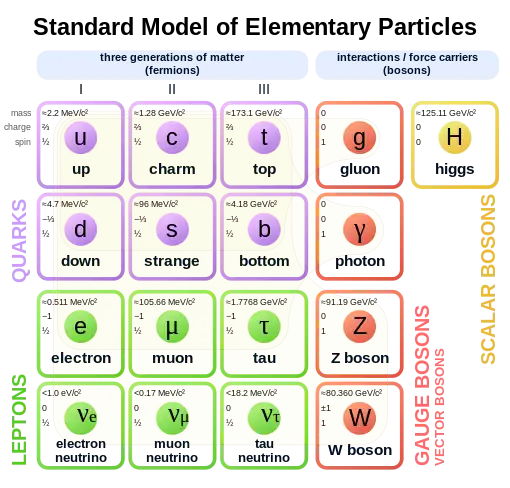
- The only fundamental scalar boson in the Standard Model of particle physics is the Higgs boson,[1] the existence of which was confirmed on 14 March 2013 at the Large Hadron Collider by CMS and ATLAS.[4] As a result of this confirmation, the 2013 Nobel Prize in physics was awarded to Peter Higgs and François Englert.[5]
- Various known composite particles are scalar bosons, e.g. the alpha particle and scalar mesons.[6]
- The φ4-theory or quartic interaction is a popular "toy model" quantum field theory that uses scalar bosonic fields, used in many introductory quantum textbooks[7] to introduce basic concepts in field theory.
Pseudoscalar
- There are no fundamental pseudoscalars in the Standard Model, but there are pseudoscalar mesons, like the pion.[8]
See also
References
- 1 2 "The scalar boson". ATLAS Collaboration. March 26, 2015. Retrieved May 22, 2021.
- ↑ Nave, R. "Spin classification of particles". Retrieved June 8, 2021.
- ↑ Thomson, Mark (2011). "Handout 9: The Weak Interaction and V-A" (PDF). Retrieved June 6, 2021.
- ↑ "New results indicate that particle discovered at CERN is a Higgs boson" (Press release). 14 March 2013. Retrieved 22 May 2021.
- ↑ "The Nobel Prize in Physics for 2013" (Press release). Nobel Media AB. 2013. Retrieved 22 May 2021.
- ↑ Qaim, Syed M.; Spahn, Ingo; Scholten, Bernhard; Neumaier, Bernd (8 June 2016). "Uses of alpha particles, especially in nuclear reaction studies and medical radionuclide production". Radiochimica Acta. 104 (9): 601. doi:10.1515/ract-2015-2566. S2CID 56100709. Retrieved 22 May 2021.
- ↑ Peskin, Michael E.; Schroeder, Daniel V. (1995). An Introduction to Quantum Field Theory. Westview Press. ISBN 978-0-201-50397-5.
- ↑ Nave, R. "Hadrons, baryons, mesons". Retrieved May 23, 2021.
| Elementary |
| ||||||||||||||||||||||||
|---|---|---|---|---|---|---|---|---|---|---|---|---|---|---|---|---|---|---|---|---|---|---|---|---|---|
| Composite |
| ||||||||||||||||||||||||
| Quasiparticles | |||||||||||||||||||||||||
| Lists | |||||||||||||||||||||||||
| Related | |||||||||||||||||||||||||

This article is issued from Wikipedia. The text is licensed under Creative Commons - Attribution - Sharealike. Additional terms may apply for the media files.