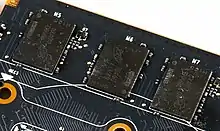
Video random-access memory (VRAM) is dedicated computer memory used to store the pixels and other graphics data as a framebuffer to be rendered on a computer monitor.[1] It often uses a different technology than other computer memory, in order to be read quickly for display on a screen.
Relation to GPUs
.jpg.webp)
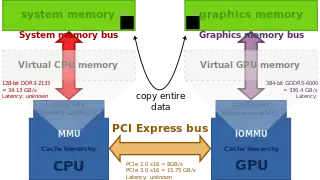
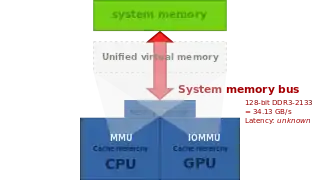
Many modern GPUs rely on VRAM. In contrast, a GPU that does not use VRAM, and relies instead on system RAM, is said to have a unified memory architecture, or shared graphics memory.
System RAM and VRAM have been segregated due to the bandwidth requirements of GPUs,[2][3] and to achieve lower latency, since VRAM is physically closer to the GPU die.[4]
Modern VRAM is typically found in a BGA package[5] soldered onto a graphics card.[6] The VRAM is cooled along with the GPU by the GPU heatsink.[7]
Technologies
- Dual-ported video RAM, used in the 1990s and at the time often called "VRAM"
- SGRAM
- GDDR SDRAM
- High Bandwidth Memory (HBM)[8]
See also
- Graphics processing unit
- Tiled rendering, a method to reduce VRAM bandwidth requirements[9]
References
- ↑ Foley, James D.; van Dam, Andries; Feiner, Steven K.; Hughes, John F. (1997). Computer Graphics: Principles and Practice. Addison-Wesley. p. 859. ISBN 0-201-84840-6.
- ↑ "What is VRAM: The Memory Power Behind Real-time Ray-Tracing".
- ↑ "Relationship Between RAM and VRAM Bandwidth and Their Latency".
- ↑ "RAM vs. VRAM: What's the Difference?". makeuseof.com.
- ↑ "Encapsulated in CPUs, GPUs, RAM and Flash: Types and Uses".
- ↑ "Graphics Card Components & Connectors Explained".
- ↑ "Different Types of Graphics Card Cooling Solutions for GPU, VRAM & VRM".
- ↑ "VRAM vs RAM | Differences & Applications". TechDim.
- ↑ "GPU Framebuffer Memory: Understanding Tiling".