| 2A46 125 mm gun | |
|---|---|
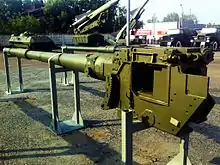 2A46M-1 in Motovilikha Plants museum | |
| Type | Smoothbore tank gun |
| Place of origin | Soviet Union |
| Service history | |
| In service | Since 1970 |
| Production history | |
| Designer | Spetstekhnika Design Bureau |
| Produced | 1970–present |
| Specifications | |
| Mass | 2A46: 2,675 kg 2A46M: 2,400 kg |
| Length | 2A46: 6,350 mm 2A46M: 6,381 mm |
| Barrel length | 6,000 mm L48 |
| Caliber | 125 mm |
| Muzzle velocity | APFSDS: 1,715-1,800 m/s
HEAT: 905-950 m/s HE: 760 m/s |
| Effective firing range | APFSDS / HEAT: 3,000 m
HE: 4,000 m ATGM: 5,000 m |
The 2A46 (also called D-81TM) is a 125 mm/L48 smoothbore cannon of Soviet origin used in several main battle tanks. It was designed by OKB-9 (Artillery Plant No. 9) in Yekaterinburg.
Description
It was developed by the Spetstekhnika Design Bureau in Ekaterinburg in the 1960s originally for the T-64 tank. They were subsequently manufactured at Artillery Plant No. 9 in Ekaterinburg and Motovilikha in Perm. Other variations include 2A46M, 2A46M-1, 2A46M-2, 2A46M-4, 2A46M-5, and Ukrainian KBA-3 and Chinese ZPT-98.
The 2A46 can fire armour-piercing fin-stabilised discarding sabot (APFSDS), high-explosive anti-tank (HEAT) and high-explosive fragmentation (HEF) projectiles. The ammunition for the 2A46 gun is in two pieces: the projectile is loaded first, followed by a separate propellant charge.
The early versions of the 2A46 suffered from a relatively short barrel life, but this was rectified on the 2A46M-1 version. Depending on the version it offers 510.00 MPa (73,969 psi) or from the 2A46M-1 650.00 MPa (94,275 psi) Pmax chamber pressure.[1]
The Ukrainian KBA-3 guns are based on the 2A46 gun. In addition, the Chinese ZPT-98 is based on 2A46M imported from Russia's T-72 or T-80.[2]
Projectiles
| Projectile specifications for 2A46 and 2A46M[3][4][5][6][7][8] Note: There are different ways to measure penetration value. NATO uses the 50% (This means that 50% of the projectile had to go through the plate), while the Soviet/Russia standard is higher (80% had to go through). According to authorities like Paul Lakowski, the difference in performance can reach as much as 8%[9] | ||||||
| Round index | Projectile index | Charge index | Round weight, kg | Projectile weight, kg | Charge weight, kg | Penetration, mm/deg[note 1] |
| APFSDS Rounds | ||||||
| 3VBM3 | 3BM9/3BM10 | 4Zh40 | 19.6 | 5.67 | 5.0/5.0+3.4 | 245mm/0°, 140mm/60° @ 2km |
| 3VBM6 | 3BM12/3BM13 | 4Zh40 | 19.6 | 5.67 | 5.0/5.0+3.4 | 380mm/0°, 140mm/60° @ 2km |
| 3VBM7 | 3BM15/3BM16 | 4Zh40 | 20.0 | 5.9 | 5.0/5.0+3.4 | 400mm/0°, 150mm/60° @ 2km |
| 3VBM8 | 3BM17/3BM18 | 4Zh40 | 20.0 | 5.9 | 5,0/5,0+3,4 | 265mm/0°, 150mm/60° @ 2km |
| 3VBM9 | 3BM22/3BM23 | 4Zh40 | 20.2 | 6.55 | 5,0/5,0+3,4 | 420mm/0°, 170mm/60° @ 2km |
| 3VBM11 | 3BM26/3BM27 | 4Zh63 | 20.43 | 7.05 | 5.3/5.3+2.9 | 410mm/0°, 200mm/60° @ 2km |
| 3VBM12 | 3BM29/3BM30 | 6.55 | 360mm /0°, 210mm/60° @ 2km | |||
| 3VBM13 | 3BM32/3BM38 | 4Zh63 | 20.55 | 7.05 | 5.3/5.3+2.9 | 395mm/0°, 230mm/60° @ 2km |
| 3VBM17 | 3BM42/3BM44 ("Mango") | 4Zh63 | 20.4 | 7.05 | 5.3/5.3+2.9 | 450mm/0°, 230mm/60° @ 2km |
| —- | 3BM44-2 (“Mango-2”) | 480mm/0°, 280mm/60° @ 2km | ||||
| 3VBM19 | 3BM42M/3BM44M ("Lekalo") | 4Zh63 | 20.4 | 7.05 | 5.3/5.3+2.9 | ???mm/0°, ???mm/60° @ 2km |
| 3VBM20 | 3BM46/3BM48 ("Svinets") | 4Zh63 | 20.4 | 7.05 | 5.3/5.3+2.9 | 495mm/0°, 290mm/60° @ 2km |
| 3VBM22 | 3BM59 ("Svinets-1") | 8.8 | ???mm/0°, 315mm/60° @ 2km | |||
| 3VBM23 | 3BM60 ("Svinets-2") | 8.1 | ???mm/0°, 300mm/60° @ 2km | |||
| 125-mm TAPNA | 6.7 | 5.5/5.5+3.3 | 460mm/0°, 270mm/60° @ 2km | |||
| ZPS Pronit[note 2] | 4Zh63 | 5.855/5.855+3.0 | 430mm/0°, 250mm/60° @ 2km | |||
| 125-I[note 3] | 23.0 | 7.37 | 430mm/0°, 250mm/60° @ 2km | |||
| 125-II / DTW-125 [note 4] | 23.0 | 7.44 | 515mm/0°, 300mm/60° @ 2km | |||
| 125-III / DTC10-125 [note 5] | ???mm/0°, 330mm/60° @ 2km | |||||
| HEAT Rounds | ||||||
| 3VBK7 | 3BK12(M) | 4Zh40 | 29.0 | 19.0 | 5.0 | 220/60° |
| 3VBK10 | 3BK14(M) | 4Zh40 | 29.0 | 19.0 | 5.0 | 220/60° |
| 3VBK16 | 3BK18(M) | 4Zh40 | 29.0 | 19.0 | 5.0 | 260/60° |
| 3VBK17 | 3BK21B | 4Zh52 | 29.0 | 19.0 | 10.0 | 260/60° |
| 3VBK25 | 3BK29(M) | 4Zh52 | 28.4 | 18.4 | 10.0 | 300/60° |
| 3VBK27 | 3BK31 | 19.0 | 350/60°[note 6] | |||
| 125-mm HEAT[note 7] | 19.0 | 200/60° | ||||
| 125-mm HEAT-T[note 8] | 33.0 | 23.0 | 10,0 | |||
| 125-mm HEAT-T[note 9] | 19.5 | 200/60° | ||||
| M88[note 10] | ||||||
| HE Rounds | ||||||
| 3VOF22 | 3OF19 | 4Zh40 | 33.0 | 23.0 | 5.0 | — |
| 3VOF36 | 3OF26 | 4Zh40 | 33.0 | 23.0 | 5.0 | — |
| Practice HEAT Rounds | ||||||
| 3VP5 | 3P11 | 4Zh40 | 29.0 | 19.0 | 5.0 | |
| Practice APFSDS Rounds | ||||||
| 3VP6 | 3P31/3P35 | 4Zh40 | 19.5 | 5.2 | 5.0/5.0+4.3 | — |
| Practice HE Rounds | ||||||
| 3VP24 | 3P23 | 4Zh40 | 33.0 | 23.0 | 5.0 | — |
| Training Rounds | ||||||
| 3VPU4 | 3PU12 | 4PU105 | 19.1 | 9.6 | — | |
| 3VPU5 | 3PU13 | 4PU105 | 28.5 | 19.0 | — | |
| 3VPU6 | 3PU14 | 4PU105 | 32.5 | 23.0 | — | |
| Inert | — | 4Kh33 | — | — | 13 | — |
| Guided weapons for 2A46-2, 2A46M and their variants | ||||||
| ATGMs[10][11][12][13][14] | ||||||
| 9M112 | 9D129 | 33.2 | 250/60° | |||
| 9M112M | 300/60° | |||||
| 9M112M2 | 31.1 | 24 | 300..350/60° | |||
| 9M124 | 33.6 | 27.9 | 450/60° | |||
| 3UBK14 | 9M119 | 9Kh949 | 23.3 | 16.5 | 7.1 | 325..375/60° |
| Sokol-1 | 4Zh63 | 23.0 | 5.3 | 350/60° | ||
| Explosive ATGMs[15][16] | ||||||
| 3UBK14F | 9M119F | 9Kh949 | 23.6 | 16.5 | 7.1 | — |
| 3UBK14F1 | 9M119F1 | 9Kh949 | 23.3 | 16.5 | 6.8 | — |
| Guided weapons for 2A46M and its variants | ||||||
| 3UBK20 | 9M119M | 9Kh949 | 24.3 | 17.2 | 7.1 | 325..375/60° |
| 3UBK20M | 9M119M1 | 9Kh949 | 24.3 | 17.2 | 7.1 | 425..450/60° |
| AP projectiles for 2A46M-5 | ||||||
| 3VBM22 | 3BM59 | 4Zh96 | 540/0° @ 2km | |||
| 3VBM23 | 3BM60 | 4Zh96 | 515/0° @ 2km | |||
| ??? | 3BM69 | ???/0° | ||||
| ??? | 3BM70 | ???/0° | ||||
Variants
Soviet Union and Russia
- 2A46-1 / DT-81TM (1970): Used on T-64A and T-72A.
- 2A46-2 / DT-81K (1976): Used on T-64B and T-80B.
- 2A46M (1981): Used on T-72AV and T-72B.
- 2A46M-1 (1981): Used on T-64BV, T-72B, T-80BV and T-80U.
- 2A46M-2 (1992): Used on T-72S and T-90.
- 2A46M-4: Used on Object 640.
- 2A82-1M: Used on T-14 Armata.[17]
Source:[18]
China
Ukraine
Tanks using the 2A46
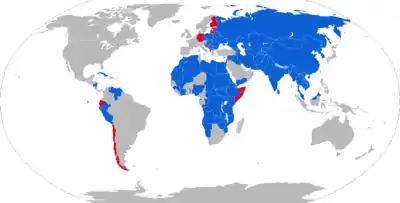
The 2A46 has been used in numerous tanks, almost exclusively Soviet/Russian designs or foreign derivatives:






.svg.png.webp)




.svg.png.webp)



.svg.png.webp)
See also
- 125 mm smoothbore ammunition
- 2A45 Sprut - Soviet towed 125 mm anti-tank gun
Weapons of comparable role, performance and era
- L11A5 120 mm rifled gun: British rifled equivalent, developed by Royal Armament Research and Development Establishment (RARDE) in 1957.
- Rheinmetall 120 mm gun: German equivalent, developed by Rheinmetall in 1974.
- CN120-25 120 mm gun: French equivalent, developed by Établissement d'Études et de Fabrication d'Armements de Bourges (EFAB) in 1979.
- EXP-28M1 120 mm rifled tank gun: Experimental British weapon of the late 1970s/early 1980s. Was to have equipped the MBT-80.
- CN120-26 120 mm gun: French equivalent, developed by EFAB in 1980s.
- IMI 120 mm gun: Israeli equivalent, developed by Israeli Military Industries in 1988.
- OTO Breda 120 mm gun: Italian equivalent, developed by OTO Melara in 1988.
- L30A1 120 mm rifled gun: British rifled equivalent, developed by ROF Nottingham in 1989.
- JSW 120 mm gun: Japanese equivalent, developed by Japan Steel Works in 2008.
- CN08 120 mm gun: South Korean equivalent, developed by Agency for Defense Development (ADD) and WIA in 2008.
- 2A82-1M 125 mm gun: New Russian 125-mm equivalent, developed by Uralvagonzavod in 2014.
- MKE 120 mm tank gun: Turkish equivalent, developed by Otokar and Hyundai WIA in 2016.
Sources
References
- ↑ "Vasiliy Fofanov's Modern Russian Armor Page". Archived from the original on 2010-08-19. Retrieved 2010-09-22.
- 1 2 Charlie Gao (20 December 2021). "Chinese Tanks Still Lag Behind Other Top Armies". The national interest. Archived from the original on 8 March 2022. Retrieved 8 March 2022.
- ↑ 2А46ТО1. 125-мм танковые пушки 2А26, 2А46, 2А46-1, 2А46М, 2А46М-1, 2А46-2. Техническое описание и инструкция по эксплуатации. Часть 3. Боеприпасы.
- ↑ Рособронэкспорт (2003) [Land forces weapons. Export catalogue]. "Вооружение сухопутных войск". Каталог экспортного вооружения. «Интервестник». p. 120.
- ↑ А. В. Карпенко (2001). "Часть 1". Каталог современного российского вооружения и конверсионной техники на международных выставках вооружений и военной техники (1992-2001 гг.). С-Пб.: «Бастион». p. 336.
- ↑ А. Хлопотов. (2009). "Танк Т-72БА: посредственная модернизация или модернизация по средствам?". Техника и вооружение: вчера, сегодня, завтра. М.: Техинформ (10): 20.
- ↑ Jane’s Ammunition Handbook 2001—2002
- ↑ Суворов С. (2003). "Танк Т-64". Техника и вооружение: вчера, сегодня, завтра (Журнал). М.: «Техинформ» (11): 28. ISSN 1682-7597.
- ↑ "Pokonać pancerz! Część III – dane amunicji APFSDS-T". Archived from the original on 2018-07-02. Retrieved 2018-12-11.
- ↑ "Противотанковая управляемая ракета "9М119 9М117"". Archived from the original on 2012-01-12. Retrieved 2013-01-20.
- ↑ А. В. Карпенко, Ракетные танки, стр. 36
- ↑ "Комплекс управляемого танкового вооружения 9К112 Кобра". Информационно-новостная система «Ракетная техника». Archived from the original on 2013-01-25. Retrieved 2013-01-20.
- ↑ Энциклопедия XXI век. Оружие и технологии России. Том 12. Средства поражения и боеприпасы, стр. 185
- ↑ Р. Ангельский. (2006). ""Кобры" стерегут страну советов". Техника и вооружение: вчера, сегодня, завтра. М.: Техинформ (7): 19.
- ↑ "Выстрел 3УБК14Ф с управляемой ракетой 9М119Ф". Завод имени В.А. Дегтярёва. Archived from the original on 2013-03-05. Retrieved 2013-02-23.
- ↑ "Выстрел 3УБК14Ф1 с управляемой ракетой 9М119Ф1". Завод имени В.А. Дегтярёва. Archived from the original on 2013-03-05. Retrieved 2013-02-23.
- ↑ "Overview". www.militaryperiscope.com. Retrieved 2022-12-23.
- ↑ "120mm and 125mm Main Guns". fofanov.armor.kiev.ua. Retrieved 2022-12-23.
- ↑ "Ukrainian Tanks". www.pmulcahy.com. Retrieved 2022-12-23.
Notes
External links
