| Anthurium wendlingeri | |
|---|---|
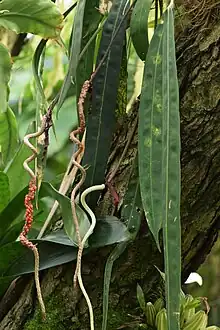 | |
| A. wendlingeri at Berlin Botanical Garden, with its corkscrew-shaped inflorescences turning into berries | |
Scientific classification  | |
| Kingdom: | Plantae |
| Clade: | Tracheophytes |
| Clade: | Angiosperms |
| Clade: | Monocots |
| Order: | Alismatales |
| Family: | Araceae |
| Genus: | Anthurium |
| Species: | A. wendlingeri |
| Binomial name | |
| Anthurium wendlingeri G.M.Barroso | |
Anthurium wendlingeri is a species of plant in the genus Anthurium found in Central and South America, from southeast Nicaragua to northwest Colombia.[1] It grows in wet tropical habitats as an epiphytic shrub with long, pendant leaves up to 7 feet (2.1 m) long that can have a slightly velvety appearance.[2]
A member of the section Porphyrochitonium,[3] A. wendlingeri is colloquially known as one of the "strap-leaved" Anthuriums, similar to Anthurium vittariifolium and Anthurium pendens, but it can be readily distinguished by its unique spiraling, corkscrew-like spadix.[4] Like many Anthurium, the species is somewhat variable and has some local varieties within its range. The varietal var. horichii, described by Croat, is found in Costa Rica.[5] The more common is subsp. wendlingeri, found across the main part of its range.[6]
References
- ↑ "Anthurium wendlingeri". Plants of the World Online. Royal Botanic Gardens, Kew.
- ↑ Offolter, Enid (2022-05-31). Welcome to the Jungle: Rare Tropical Houseplants to Collect, Grow, and Love. Clarkson Potter/Ten Speed. p. 73. ISBN 978-1-9848-5995-2.
{{cite book}}: CS1 maint: date and year (link) - ↑ Deni Bown (2000), Aroids: Plants of the Arum Family, Timber Press, p. 208, ISBN 978-0-88192-485-5
- ↑ Croat, Thomas B. (1983). "A Revision of the Genus Anthurium (Araceae) of Mexico and Central America. Part I: Mexico and Middle America". Annals of the Missouri Botanical Garden. 70 (2): 211–416. doi:10.2307/2399049. ISSN 0026-6493. JSTOR 2399049.
- ↑ "Anthurium wendlingeri var. horichii". Plants of the World Online. Royal Botanic Gardens, Kew.
- ↑ "Anthurium wendlingeri subsp. wendlingeri". Plants of the World Online. Royal Botanic Gardens, Kew.