| Arnica sororia | |
|---|---|
 | |
Scientific classification  | |
| Kingdom: | Plantae |
| Clade: | Tracheophytes |
| Clade: | Angiosperms |
| Clade: | Eudicots |
| Clade: | Asterids |
| Order: | Asterales |
| Family: | Asteraceae |
| Genus: | Arnica |
| Species: | A. sororia |
| Binomial name | |
| Arnica sororia | |
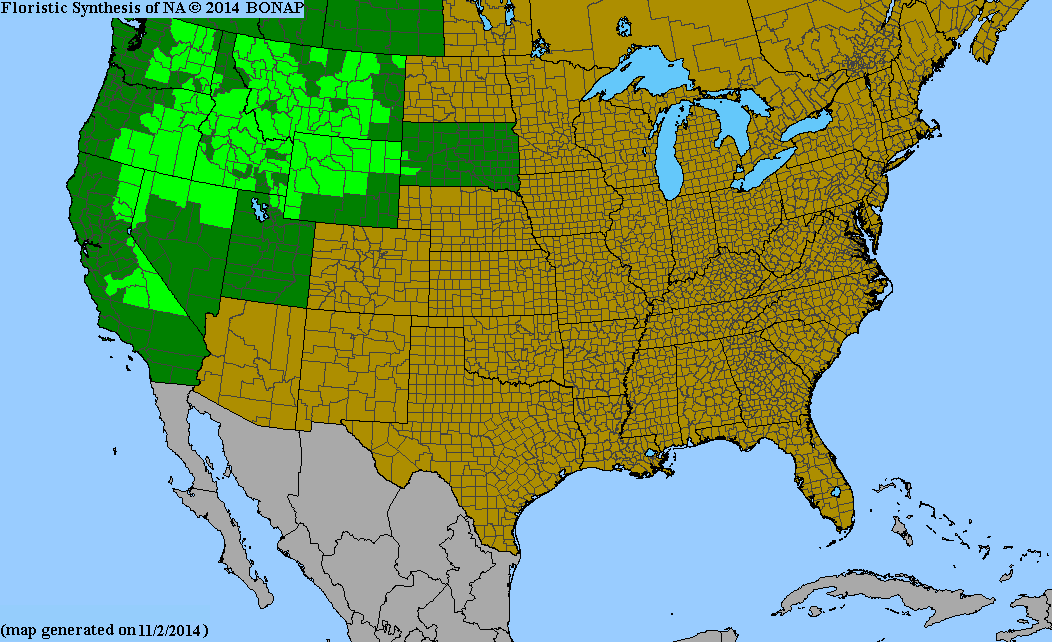
Arnica sororia is a North American species of flowering plant known by the common name twin arnica.[1] It is native to Western Canada (British Columbia, Alberta, Saskatchewan) and the Western United States (Washington, Oregon, California, Nevada, Utah, Idaho, Montana, Wyoming, South Dakota).[2] It grows in grasslands and in conifer forests,[3] as well as the sagebrush steppe.[4]
Arnica sororia is a rhizomatous perennial herb producing one or more hairy, glandular stems 10 to 50 centimeters (4 to 19+1⁄2 in) tall. There are a few to several pairs of broadly lance-shaped leaves along the stem,[4] the lower ones borne on petioles. Leaves may reach up to 14 cm long.[5]
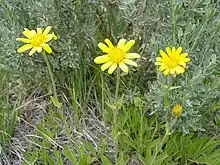
The inflorescence consists of a daisy-like flower head, rarely more than one per stem.[4] These are lined with phyllaries coated in glandular hairs. The flower head has a center of glandular yellow disc florets and a fringe of yellow ray florets. The fruit is an achene a few millimeters long with a white pappus.[5]
References
- ↑ Calflora taxon report, University of California, Arnica sororia E. Greene, twin arnica
- ↑ Biota of North America Program 2014 county distribution map
- ↑ Flora of North America Vol. 21 Page 370 Twin arnica Arnica sororia Greene
- 1 2 3 Taylor, Ronald J. (1994) [1992]. Sagebrush Country: A Wildflower Sanctuary (rev. ed.). Missoula, MT: Mountain Press Pub. Co. p. 158. ISBN 0-87842-280-3. OCLC 25708726.
- 1 2 Greene, Edward Lee 1910. Ottawa Naturalist 23(12): 213