| Cestrum aurantiacum | |
|---|---|
 | |
Scientific classification  | |
| Kingdom: | Plantae |
| Clade: | Tracheophytes |
| Clade: | Angiosperms |
| Clade: | Eudicots |
| Clade: | Asterids |
| Order: | Solanales |
| Family: | Solanaceae |
| Genus: | Cestrum |
| Species: | C. aurantiacum |
| Binomial name | |
| Cestrum aurantiacum | |
| Synonyms[2] | |
| |
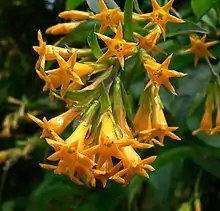
Cestrum aurantiacum[3] (orange cestrum, "orange jessamine", orange-flowering jessamine, and yellow cestrum;[4] syn. Capraria lanceolata L.f.) is native to North and South America. This plant is used as an ornamental plant, and it is a poisonous plant if eaten by animals.[5] It is regarded as medicinal in Peru.[6]
References

Wikimedia Commons has media related to Cestrum aurantiacum.
- ↑ Botanic Gardens Conservation International (BGCI); IUCN SSC Global Tree Specialist Group; Meave, J.A. (2019). "Cestrum aurantiacum". IUCN Red List of Threatened Species. 2019: e.T136788108A136788110. doi:10.2305/IUCN.UK.2019-2.RLTS.T136788108A136788110.en. Retrieved 19 December 2022.
- ↑ "The Plant List: A Working List of All Plant Species". Retrieved 8 April 2015.
- ↑ Cestrum aurantiacum at USDA PLANTS Database
- ↑ Cestrum aurantiacum Archived September 30, 2007, at the Wayback Machine at Swaziland's Flora Database Archived July 13, 2007, at the Wayback Machine
- ↑ "Cestrum aurantiacum". Germplasm Resources Information Network. Agricultural Research Service, United States Department of Agriculture. Retrieved 16 January 2018.
- ↑ Cestrum aurantiacum at Universal Postal Union - stamps of Peru]
This article is issued from Wikipedia. The text is licensed under Creative Commons - Attribution - Sharealike. Additional terms may apply for the media files.