| DPH1 | |||||||||||||||||||||||||||||||||||||||||||||||||||
|---|---|---|---|---|---|---|---|---|---|---|---|---|---|---|---|---|---|---|---|---|---|---|---|---|---|---|---|---|---|---|---|---|---|---|---|---|---|---|---|---|---|---|---|---|---|---|---|---|---|---|---|
| Identifiers | |||||||||||||||||||||||||||||||||||||||||||||||||||
| Aliases | DPH1, DPH2L, DPH2L1, OVCA1, DEDSSH, diphthamide biosynthesis 1 | ||||||||||||||||||||||||||||||||||||||||||||||||||
| External IDs | OMIM: 603527 MGI: 2151233 HomoloGene: 1059 GeneCards: DPH1 | ||||||||||||||||||||||||||||||||||||||||||||||||||
| |||||||||||||||||||||||||||||||||||||||||||||||||||
| |||||||||||||||||||||||||||||||||||||||||||||||||||
| |||||||||||||||||||||||||||||||||||||||||||||||||||
| |||||||||||||||||||||||||||||||||||||||||||||||||||
| |||||||||||||||||||||||||||||||||||||||||||||||||||
| Wikidata | |||||||||||||||||||||||||||||||||||||||||||||||||||
| |||||||||||||||||||||||||||||||||||||||||||||||||||
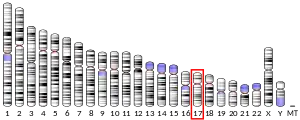





Diphthamide biosynthesis protein 1 is a protein that in humans is encoded by the DPH1 gene.[5][6][7] It encodes a protein that performs posttranslational modification of histidine-715[8] on eukaryotic translation elongation factor 2 to diphthamide. This modification appears to be important in the translation of Cyclin D in ovarian cells. DPH1 is mutated in 90% of ovarian cancers end stage, usually by loss of heterozygosity.
References
- 1 2 3 GRCh38: Ensembl release 89: ENSG00000108963 - Ensembl, May 2017
- 1 2 3 GRCm38: Ensembl release 89: ENSMUSG00000078789 - Ensembl, May 2017
- ↑ "Human PubMed Reference:". National Center for Biotechnology Information, U.S. National Library of Medicine.
- ↑ "Mouse PubMed Reference:". National Center for Biotechnology Information, U.S. National Library of Medicine.
- ↑ Phillips NJ, Zeigler MR, Deaven LL (May 1996). "A cDNA from the ovarian cancer critical region of deletion on chromosome 17p13.3". Cancer Lett. 102 (1–2): 85–90. doi:10.1016/0304-3835(96)04169-9. PMID 8603384.
- ↑ Liu S, Milne GT, Kuremsky JG, Fink GR, Leppla SH (Oct 2004). "Identification of the proteins required for biosynthesis of diphthamide, the target of bacterial ADP-ribosylating toxins on translation elongation factor 2". Mol Cell Biol. 24 (21): 9487–97. doi:10.1128/MCB.24.21.9487-9497.2004. PMC 522255. PMID 15485916.
- ↑ "Entrez Gene: DPH1 DPH1 homolog (S. cerevisiae)".
- ↑ Webb TR, Cross SH, McKie L, Edgar R, Vizor L, Harrison J, Peters J, Jackson IJ (2008). "Diphthamide modification of eEF2 requires a J-domain protein and is essential for normal development". J. Cell Sci. 121 (Pt 19): 3140–5. doi:10.1242/jcs.035550. PMC 2592597. PMID 18765564.
Diphthamide modification is present in all eukaryotic organisms, in which it is restricted to a histidine residue of translation elongation factor 2 (eEF2, also known as EFT1; position 715 in mammals and 699 in yeast)
Further reading
- Schultz DC, Vanderveer L, Berman DB, et al. (1996). "Identification of two candidate tumor suppressor genes on chromosome 17p13.3". Cancer Res. 56 (9): 1997–2002. PMID 8616839.
- Bruening W, Prowse AH, Schultz DC, et al. (1999). "Expression of OVCA1, a candidate tumor suppressor, is reduced in tumors and inhibits growth of ovarian cancer cells". Cancer Res. 59 (19): 4973–83. PMID 10519411.
- Salicioni AM, Xi M, Vanderveer LA, et al. (2001). "Identification and structural analysis of human RBM8A and RBM8B: two highly conserved RNA-binding motif proteins that interact with OVCA1, a candidate tumor suppressor". Genomics. 69 (1): 54–62. doi:10.1006/geno.2000.6315. PMID 11013075.
- Chen CM, Behringer RR (2001). "Cloning, structure, and expression of the mouse Ovca1 gene". Biochem. Biophys. Res. Commun. 286 (5): 1019–26. doi:10.1006/bbrc.2001.5488. PMID 11527402.
- Strausberg RL, Feingold EA, Grouse LH, et al. (2003). "Generation and initial analysis of more than 15,000 full-length human and mouse cDNA sequences". Proc. Natl. Acad. Sci. U.S.A. 99 (26): 16899–903. Bibcode:2002PNAS...9916899M. doi:10.1073/pnas.242603899. PMC 139241. PMID 12477932.
- Cardoso C, Leventer RJ, Ward HL, et al. (2003). "Refinement of a 400-kb critical region allows genotypic differentiation between isolated lissencephaly, Miller-Dieker syndrome, and other phenotypes secondary to deletions of 17p13.3". Am. J. Hum. Genet. 72 (4): 918–30. doi:10.1086/374320. PMC 1180354. PMID 12621583.
- Ota T, Suzuki Y, Nishikawa T, et al. (2004). "Complete sequencing and characterization of 21,243 full-length human cDNAs". Nat. Genet. 36 (1): 40–5. doi:10.1038/ng1285. PMID 14702039.
- Rual JF, Venkatesan K, Hao T, et al. (2005). "Towards a proteome-scale map of the human protein-protein interaction network". Nature. 437 (7062): 1173–8. Bibcode:2005Natur.437.1173R. doi:10.1038/nature04209. PMID 16189514. S2CID 4427026.
This article is issued from Wikipedia. The text is licensed under Creative Commons - Attribution - Sharealike. Additional terms may apply for the media files.