| Dumfries Museum and Camera Obscura | |
|---|---|
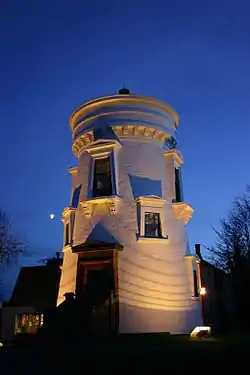 Exterior view of the Camera Obscura | |
| General information | |
| Architectural style | Victorian and modern |
| Town or city | Dumfries |
| Country | Scotland |
| Coordinates | 55°03′55″N 3°36′53″W / 55.0652°N 3.6146°W |
| Renovated | 2011 |
Dumfries Museum and Camera Obscura, located in Dumfries in Dumfries & Galloway, is the largest museum in the region. The museum has extensive collections relating to local and history from the pre-historic era. The museum also has the world's oldest working Camera Obscura. Admission is free, however a small fee applies for the Camera Obscura.
Collections
The museum's collections cover all material relating to the natural history and human pre-history of the region, from geology to dress, folk material, archaeology and early photographs.[1]
Notable artefacts include:
- A cast of the skull of Robert the Bruce as well as femur and foot bones.[2]
- A Bronze Age cist burial including the remains of a 35-year-old man from the beaker people.[3]
- A large collection of Roman and Celtic stone crosses and funerary monuments.[4][5]
- A replica of the first bicycle, as designed by Kirkpatrick Macmillan.[6]
- The photographic archive of Dr Werner Kissling.[7]
- Personal items belonging to Thomas Carlyle[8]
- Fossil reptile tracks from the local Permian sandstone including Corncockle Quarry.[9]
History
Originally built as a four-storey windmill on Corbelly hill, the highest point in Maxwelltown, in 1798, the site was purchased by Dumfries and Maxwellton Astronomical Society in 1834.[10] Over a two-year period the tower was converted into an Observatory,[11] and with advice from polar explorer Sir John Ross, a telescope was purchased from a Mr Morton of Kilmarnock. With its completion in 1836, unfortunately the observatory missed the arrival of Halley's comet; however, it was used in this role until 1872.
The main hall of the museum was built in 1862, and housed the collections of the newly founded Dumfries and Galloway Natural History & Antiquarian Society. In 1981 a major addition of a new gallery, shop, search room and offices for curatorial staff was added. In 2011 the exterior of the windmill tower was refurbished.[12]
Camera Obscura
The camera obscura is currently the oldest working example in the world, and has been in continuous operation since 1836.[13] The instrument, based in the top level of the windmill tower, offers a complete 360° panorama of the surrounding landscape. The image is projected onto a focusing table below, and operated using a simple rope mechanism.[14] In order to protect the instrument it is only operated during the summer months and on days when weather conditions are clear.[15] The museums photographic expert for thirty years was Werner Kissling who donated his photos to the museum when he died.[16]
References
- ↑ "Dumfries Museum & Camera Obscura".
- ↑ "Robert the Bruce, cast of his skull".
- ↑ "Cist burial, Mainsriddle, Colvend and Southwick".
- ↑ "Ritual and religion".
- ↑ "Early Christians".
- ↑ "Replica of Kirkpatrick Macmillan's bicycle".
- ↑ "Dr Werner Kissling".
- ↑ "Thomas Carlyle".
- ↑ Jardine, Sir William (1853). The Ichnology of Annandale or Illustrations of Footmarks Impressed on the New Red Sandstone of Corncockle Muir.
- ↑ "I like – Happy to be a part of the industry of human happiness".
- ↑ "History of the Burgh of Dumfries".
- ↑ "Dumfries Museum & Camera Obscura Feature Page on Undiscovered Scotland".
- ↑ "Dumfries Museum and Camera Obscura, Dumfries – Museums".
- ↑ "I like – Happy to be a part of the industry of human happiness".
- ↑ "Dumfries Museum - DG Culture | Dumfries and Galloway Culture | Museums and galleries - Dumfries and Galloway Council | Festivals | Events | Exhibitions | Whats on Dumfries and Galloway".
- ↑ "Dr Werner Kissling". www.futuremuseum.co.uk. Retrieved 22 November 2022.