| Euphorbia tuckeyana | |
|---|---|
.jpg.webp) | |
| Euphorbia tuckeyana at Chã das Caldeiras | |
Scientific classification  | |
| Kingdom: | Plantae |
| Clade: | Tracheophytes |
| Clade: | Angiosperms |
| Clade: | Eudicots |
| Clade: | Rosids |
| Order: | Malpighiales |
| Family: | Euphorbiaceae |
| Genus: | Euphorbia |
| Species: | E. tuckeyana |
| Binomial name | |
| Euphorbia tuckeyana | |
| Synonyms | |
| |

Euphorbia tuckeyana is a species of flowering plants of the family Euphorbiaceae.[2] The species is endemic to Cape Verde.[3] The species is named after James Hingston Tuckey. Its local name is tortolho. The plants are used for tanning hides.[4] As most other succulent members of the genus Euphorbia, its trade is regulated under Appendix II of CITES.[5]
Description
.jpg.webp)
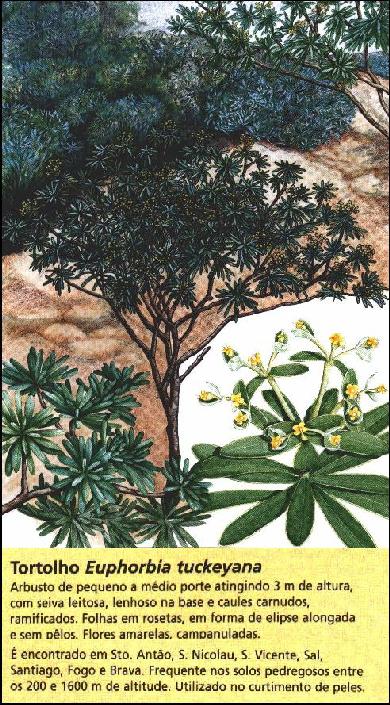
Euphorbia tuckeyana is a shrub that can reach 3 m height. It has milky sap. Its elliptical leaves are placed in rosettes. It has yellow flowers.[4]
Distribution and ecology
Euphorbia tuckeyana occurs on most of the Cape Verde islands, but not on Maio.[3] It grows in semi-arid, sub-humid and humid zones, between 100 and 2,500 metres elevation. The plants grow in rocky places and escarpments. It is characteristic of the endemic vegetation of the Cape Verde Islands.[1]
References
- 1 2 Catarino, S.; Duarte, M.C.; Romeiras, M.M. (2017). "Euphorbia tuckeyana". IUCN Red List of Threatened Species. 2017: e.T107426286A107468192. doi:10.2305/IUCN.UK.2017-3.RLTS.T107426286A107468192.en. Retrieved 19 November 2021.
- ↑ "Euphorbia tuckeyana". World Checklist of Selected Plant Families. Royal Botanic Gardens, Kew – via The Plant List. Note that this website has been superseded by World Flora Online
- 1 2 Oromí, Martín, Zurita & Cabrera, 2005 : Lista preliminar de especies silvestres de Cabo Verde: Hongos, Plantas y Animales Terrestres. Gobierno de Canarias, Consejería de Medio Ambiente y Ordenación Territorial, p. 44
- 1 2 Plantas endémicas e arvores indígenas de Cabo Verde
- ↑ "Species+". Retrieved 7 February 2023.
Further reading

- The endemic vascular plants of the Cape Verde Islands, W Africa, Sommerfeltia 24, 1997, C. Brochmann, Ø. H. Rustan, W. Lobin & N. Kilian, ISSN 0800-6865, ISBN 82-7420-033-0
- Schmidt, Johann Anton (1852). Beiträge zur Flora der Cap Verdischen Inseln. p. 64.