| History | |
|---|---|
 United Kingdom United Kingdom | |
| Name | HMS Acheron |
| Builder | HM Dockyard, Chatham |
| Laid down | 26 August 1944 |
| Launched | 25 March 1947 |
| Commissioned | 17 April 1948 |
| Decommissioned | February 1971 |
| Identification | P411 |
| Fate | Sold for scrap, 1972 |
| General characteristics | |
| Class and type | Amphion-class submarine |
| Displacement | 1,360/1,590 tons (surface/submerged) |
| Length | 293 ft 6 in (89.46 m) |
| Beam | 22 ft 4 in (6.81 m) |
| Draught | 18 ft 1 in (5.51 m) |
| Propulsion | 2 × 2,150 hp (1,600 kW) Admiralty ML 8-cylinder diesel engine, 2 × 625 hp (466 kW) electric motors for submergence driving two shafts |
| Speed |
|
| Test depth | 350 ft (110 m) |
| Complement | 60 |
| Armament |
|
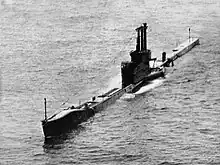
HMS Acheron (P411) was an Amphion-class submarine of the Royal Navy, laid down 26 August 1944, launched 25 March 1947 and completed in 1948.
Design
Like all Amphion-class submarines, Acheron had a displacement of 1,360 tonnes (1,500 short tons) when at the surface and 1,590 tonnes (1,750 short tons) while submerged. It had a total length of 293 feet 6 inches (89.46 m), a beam of 22 feet 4 inches (6.81 m), and a draught of 18 feet 1 inch (5.51 m). The submarine was powered by two Admiralty ML eight-cylinder diesel engines generating a power of 2,150 horsepower (1,600 kW) each. It also contained four electric motors each producing 625 horsepower (466 kW) that drove two shafts.[1] It could carry a maximum of 219 tonnes (241 short tons) of diesel, although it usually carried between 159 and 165 tonnes (175 and 182 short tons).[1]
The submarine had a maximum surface speed of 18.5 knots (34.3 km/h; 21.3 mph) and a submerged speed of 8 knots (15 km/h; 9.2 mph).[2] When submerged, it could operate at 3 knots (5.6 km/h; 3.5 mph) for 90 nautical miles (170 km; 100 mi) or at 8 knots (15 km/h; 9.2 mph) for 16 nautical miles (30 km; 18 mi). When surfaced, it was able to travel 15,200 nautical miles (28,200 km; 17,500 mi) at 10 knots (19 km/h; 12 mph) or 10,500 nautical miles (19,400 km; 12,100 mi) at 11 knots (20 km/h; 13 mph).[1] Acheron was fitted with ten 21 inches (530 mm) torpedo tubes, one QF 4 inch naval gun Mk XXIII, one Oerlikon 20 mm cannon, and a .303 British Vickers machine gun. Its torpedo tubes were fitted to the bow and stern, and it could carry twenty torpedoes. Its complement was sixty-one crew members.[1]
Service history
Acheron took part in the Coronation Review of the Fleet to celebrate the Coronation of Queen Elizabeth II in 1953.[3] It carried out 'General Naval Service' around the UK until the end of 1964. A geomagnetic storm in February 1956, during solar cycle 19, interfered with radio communications and prompted a search for the submarine after it lost radio contact.[4] From August to December 1959, It took part in a cruise to South Africa and Pakistan.[5]
It was decommissioned and broken up in 1972 at the yard of J Cashmore of Newport.[6]
Commanding officers
| From | To | Captain |
|---|---|---|
| 1949 | 1949 | Lieutenant-Commander F D G Challis DSC RN |
| 1953 | 1953 | Lieutenant S H Kempster RN |
| 1956 | 1956 | Lieutenant J Fieldhouse RN |
| 1965 | 1966 | Lieutenant D C Elliot RN |
References
- 1 2 3 4 Paul Akermann (1 November 2002). Encyclopedia of British Submarines 1901–1955. Periscope Publishing Ltd. p. 422. ISBN 978-1-904381-05-1.
- ↑ "Acheron class". World Naval Ships, Cranston Fine Arts. Retrieved 20 August 2015.
- ↑ Souvenir Programme, Coronation Review of the Fleet, Spithead, 15 June 1953, HMSO, Gale and Polden
- ↑ "Missing British Sub Feared Lost, Safe; Search Called Off" (PDF). Amsterdam Evening Recorder. Vol. LXXVII, no. 158. Amsterdam, New York. 24 February 1956. p. 1. Retrieved 22 September 2018.
- ↑ "Acheron Pays Visit to Africa and Karachi: Splendid Christmas at sea". Navy News. February 1960. p. 5. Retrieved 22 September 2018.
- ↑ "Acheron". Uboat.net. Retrieved 20 August 2015.
Publications
- Colledge, J. J.; Warlow, Ben (2006) [1969]. Ships of the Royal Navy: The Complete Record of all Fighting Ships of the Royal Navy (Rev. ed.). London: Chatham Publishing. ISBN 978-1-86176-281-8.