Jan de Weryha-Wysoczański | |
|---|---|
 De Weryha-Wysoczański in 2014 | |
| Born | 1 October 1950 |
| Education | Academy of Fine Arts in Gdańsk |
| Known for | Sculpture |
| Awards | Prix du Jury, Salon de Printemps, Luxembourg Golden Owl |

Jan Michał, 6th Chevalier de Weryha-Wysoczański-Pietrusiewicz[1][2][3][4] (born 1 October 1950), known as Jan de Weryha-Wysoczański, is a Polish sculptor,[5][6] process artist[7] and concrete artist.[8] He was born in Gdańsk.[5][6] From 1971 to 1976 he studied sculpture at the Academy of Fine Arts in Gdańsk.[5][6] Since 1981, he has been living and working in Hamburg.[5] In 1998, he won the 1st prize, the Prix du Jury, awarded by the Ministry of Culture of the Grand Duchy of Luxembourg at the 'Salon de Printemps 98', Luxembourg.[5][6][9] In 1999, he created a monument in memory of the deportees of the 1944 Warsaw Uprising for the memorial to the victims of the Neuengamme Nazi concentration camp at Hamburg,[5][6][10][11] in 2012 a memorial for the Nazi forced labourers in Hamburg-Bergedorf.[12][13] He was represented by Galerie Kellermann in Düsseldorf. In 2022 de Weryha-Wysoczański was awarded in Vienna the Golden Owl culture award in the category Visual Arts.[14]
He comes from an old noble family of Walachian[15] boyar[16] stock and legend has it that his coat of arms is borne by the descendants of Attila the Hun.[17] His only son Rafael is a writer, his uncle Basil was a rich 19th century philanthropist.[1][15] A son of his aunt Anna[18] was composer Yaroslav Yaroslavenko. Another cousin was industrialist, novelist and playwright Bronislas, 3rd Chevalier de Minkowicz-Wysoczański.[19]
Works in museum collections
Sammlung de Weryha
Hamburg is the location of the "Sammlung de Weryha", which is based in the former depository of the palace museum Hamburg-Bergedorf. Most of the collection, composed of works by the artist and supported by a Friends organisation, is permanently being on display in the exhibition rooms.[20]
Exhibitions (selection)
- 1978 60th Anniversary of the Greater Poland Uprising in Art, City Gallery BWA Arsenał, Poznań
- 1989 Autumn Salon, Kunsthaus Hamburg, Hamburg
- 1990 Germany in Montana, Gallery of Visual Arts, Missoula, Montana
- 1993 Selected Art Work from the Federal Republic of Germany and The United States: A Traveling Exhibition, Paris Gibson Square Museum of Art, Great Falls, Montana
- 1998 Spring Salon '98, Luxembourg Artist Center, Municipal Theater, Luxembourg
- 2004 Strictly Wood. Heiner Szamida, Helga Weihs, Jan de Weryha, Kunsthalle Wilhelmshaven, Wilhelmshaven
- 2004 Jan de Weryha-Wysoczański – Wooden Cube from the Wooden Cube Series, Chapel Gallery, Polish Sculpture Center, Orońsko
- 2005 Jan de Weryha-Wysoczański – Epiphanies of Nature in the Late-Modern World, Szyb Wilson Gallery, Katowice
- 2005 Jan de Weryha-Wysoczański – Wood – Archive, Patio Gallery, Łódź
- 2006 Jan de Weryha-Wysoczański – Revelations in Wood – Orońsko 2006, Museum of Contemporary Sculpture, Orońsko
- 2006 XV International Sculpture Triennial – Sensitivity, "Zamek" Culture Center, Poznań
- 2006 Jan de Weryha-Wysoczański – Revelations in Wood, City Gallery BWA, Jelenia Góra
- 2008 Alphabet of the Sculpture DEF..., Museum of Contemporary Sculpture, Orońsko
- 2009 Jan de Weryha-Wysoczański – Tabularium, Gdańsk City Gallery, Gdańsk
- 2009 XVI International Sculpture Triennial – Crisis of the Genre, "Zamek" Culture Center, Poznań
- 2010 Wood as Sculpture Material, Museum of Contemporary Sculpture, Orońsko
- 2011 Hamburg Art Week 2011, Chilehaus, Hamburg
- 2013 NordArt 2013, Carlshütte, Büdelsdorf
- 2013 PROJECT BERLIN RELOAD, FACTORY-ART GALLERY, Berlin
- 2015 Alphabet of the Sculpture VWZŹ..., Museum of Contemporary Sculpture, Orońsko
- 2015 Mailights 2015: Günther Uecker, Otto Piene, Heinz Mack, Jan de Weryha, Manfred Binzer, Galerie Kellermann, Düsseldorf
- 2018 Wood Sculpture in the Work of Polish Artists 1918-2018, Władysław Count Zamoyski City Gallery in Zakopane, among others from the collections of the Zachęta National Gallery of Art, Warsaw, and the State Art Gallery, Sopot
- 2021 Kunst Schaffen, Robbe & Berking Yachting Heritage Centre, Flensburg, with Klaus Fußmann, Ingo Kühl among others.[21]
Gallery

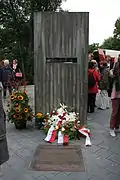 Memorial for the Nazi forced labourers in Hamburg-Bergedorf, 2012
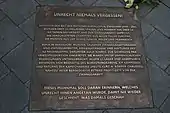 Memorial for the Nazi forced labourers (detail) in Hamburg-Bergedorf, 2012
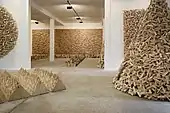 Sammlung de Weryha in Hamburg housing a permanent exhibition of the works of the artist
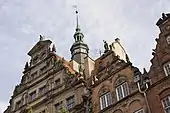 A sculpture on the façade of the English House (left) in Gdańsk was reconstructed by the artist at the beginning of the 1980s
References
- 1 2 Genealogisches Handbuch des Adels, Adelige Häuser XXX, Limburg a. d. Lahn 2008, vol 145, pp. 412–420, ISBN 978-3-7980-0845-8, OCLC 1570546.
- ↑ Who is Who in der Bundesrepublik Deutschland, 7th edition, Verlag für Personenenzyklopädien AG: Zug 2000, p. 3800, ISBN 3-7290-0030-6, OCLC 436805281.
- ↑ Gothaisches Genealogisches Handbuch, Adelige Häuser IV, Marburg 2018, vol 8, p. 493, ISBN 978-3-9817243-7-0,OCLC 995606854.
- ↑ First and middle names plus triple barrelled surname with title of nobility cited in Feuß, Axel, "Weryha-Wysoczański, Jan de", Allgemeines Künstlerlexikon - Internationale Künstlerdatenbank - Online: Allgemeines Künstlerlexikon Online / Artists of the World Online, edited by Andreas Beyer, Bénédicte Savoy and Wolf Tegethoff, Berlin, Boston: K. G. Saur, 2009.
- 1 2 3 4 5 6 Encyklopedia polskiej emigracji i Polonii (Encyclopedia of the Polish Emigration and of the Poles Abroad), Toruń 2005, vol V, pp. 234–5, ISBN 83-89376-15-6, OCLC 315323037.
- 1 2 3 4 5 Polak w świecie. Leksykon Polonii i Polaków za granicą (The Pole in the World, Encyclopedia of the Polish Living Abroad), Warsaw 2001, p. 336, ISBN 83-223-2693-9, OCLC 47863843.
- ↑ Jan de Weryha-Wysoczański – Revelations in Wood – Orońsko 2006, Orońsko: Museum of Contemporary Sculpture, Polish Sculpture Centre 2006, p. 6, ISBN 8389327376, OCLC 957590173.
- ↑ Daniel Spanke, Strenges Holz. Heiner Szamida, Helga Weihs, Jan de Weryha, Bielefeld 2004, p. 7, ISBN 3-936848-05-X, OCLC 1049130586.
- ↑ Kürschners Handbuch der Bildenden Künstler. Deutschland, Österreich, Schweiz, Munich 2005, vol II, p. 864, ISBN 3-598-24734-6.
- ↑ Taz Hamburg, 27 April 1999.
- ↑ Hamburger Abendblatt, 27 April 1999.
- ↑ Bild, 22 September 2012.
- ↑ Hamburger Morgenpost, 22 September 2012.
- ↑ Beata Dżon-Ozimek, Każda nagroda dowodzi, że spośród bardzo wielu zauważamy jedynie tak niewielu. Zamiast Gali Złotych Sów, Angora-Peryskop, no 16 (17 IV 2022), p. 76.
- 1 2 Gothaisches Genealogisches Handbuch, Adelige Häuser IV, Marburg 2018, vol 8, p. 487, ISBN 978-3-9817243-7-0, OCLC 995606854.
- ↑ Chevalier Rafael de Weryha-Wysoczański, A Chevalier from Poland. The Memoirs of Chevalier Rafael de Weryha-Wysoczański, Kibworth Beauchamp 2016, p. 1, ISBN 978-1785891618, OCLC 956765261.
- ↑ Kasper Niesiecki, Herbarz Polski, vol IX, Leipzig 1841, pp. 447-9.
- ↑ Gothaisches Genealogisches Handbuch, Adelige Häuser IV, Marburg 2018, vol 8, p. 498, ISBN 978-3-9817243-7-0,OCLC 995606854.
- ↑ Chevalier Rafael de Weryha-Wysoczański, A Chevalier from Poland. The Memoirs of Chevalier Rafael de Weryha-Wysoczański, Kibworth Beauchamp 2016, p. 4, ISBN 978-1785891618, OCLC 956765261.
- ↑ Chevalier Rafael de Weryha-Wysoczański, A Chevalier from Poland. The Memoirs of Chevalier Rafael de Weryha-Wysoczański, Kibworth Beauchamp 2016, p. 46, ISBN 978-1785891618, OCLC 956765261.
- ↑ "Kunst Schaffen". Yachting Heritage Centre, Flensburg. 2021.
Bibliography
- Axel Feuß: Weryha-Wysoczański, Jan de, in: Allgemeines Künstlerlexikon. Die Bildenden Künstler aller Zeiten und Völker (AKL), vol. 116, Berlin, Boston: de Gruyter 2022, pp. 2-3, ISBN 978-31-1077-593-8, OCLC 464627280.
External links

- Works by or about Jan de Weryha-Wysoczański in libraries (WorldCat catalogue)
- Jisc Library Hub Discover
- Newton Library Catalogue, University of Cambridge
- Sammlung de Weryha
- Freundeskreis der Sammlung de Weryha
- Jan de Weryha-Wysoczański at the Porta Polonica Documentation Centre