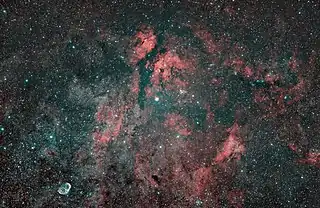
  | |
| Observation data Epoch J2000.0 Equinox J2000.0 (ICRS) | |
|---|---|
| Constellation | Cygnus |
| Right ascension | 20h 25m 58.04s[1] |
| Declination | +38° 21′ 07.7″[1] |
| Apparent magnitude (V) | 11.14[2] (10.60 - 11.74[3]) |
| Characteristics | |
| Spectral type | M3 Ia[4] (M3.5 Ia[5]) |
| U−B color index | +2.91[2] |
| B−V color index | +3.39[2] |
| Variable type | Lc[5] |
| Astrometry | |
| Proper motion (μ) | RA: –3.556[1] mas/yr Dec.: –6.061[1] mas/yr |
| Parallax (π) | 0.6687 ± 0.0517 mas[1] |
| Distance | 4,900 ± 400 ly (1,500 ± 100 pc) |
| Absolute magnitude (MV) | –8.18[6] |
| Details | |
| Radius | 1,033[7] – 1,420[6] R☉ |
| Luminosity | 138,000[2] – 270,000[6][8] L☉ |
| Surface gravity (log g) | −0.5 (−0.9?)[6] cgs |
| Temperature | 3,550[9] K |
| Other designations | |
| Database references | |
| SIMBAD | data |
KY Cygni is a red supergiant of spectral class M3.5Ia located in the constellation Cygnus. It is approximately 5,000 light-years away.
Observations
KY Cyg lies near the bright open cluster NGC 6913, but is not thought to be a member. The location is close to the bright star γ Cygni.[10] It was identified as a variable star in 1930,[11] and later named as KY Cygni.[12] The spectrum was given the MK classification of M3 Ia, with only minor adjustments since.[4]
KY Cygni is heavily reddened due to interstellar extinction, losing an estimated 7.75 magnitudes at visual wavelengths. It would be a naked eye star if no light was lost.[6]
Properties
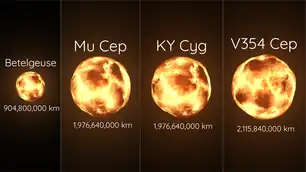
KY Cygni is classified as a luminous red supergiant with a strong stellar wind. It is losing mass at around 4.9×10⁻⁶ M☉ and has been described as a cool hypergiant.[2][13]
Its properties are uncertain, but the temperature is around 3,500 K. A model fit based on K-band infrared brightness gives a luminosity of 273,000 L☉, corresponding to a radius of 1,420 R☉. Another model based on visual brightness gives an unexpectedly large luminosity of 1,107,000 L☉, with the difference due mainly to the assumptions about the level of extinction. The radius corresponding to the higher luminosity would be 2,850 R☉. These parameters are larger and more luminous than expected for any red supergiant, making them doubtful.[6] More recently, integration of the spectral energy distributions across a full range of wavelengths from U band to the 60 micron microwave flux gives an even lower luminosity of 138,000 L☉,[2] and calculation of the bolometric luminosity based on its Gaia Data Release 2 parallax gives a luminosity below 70,000 L☉ with a corresponding radius of 672 R☉.[9]
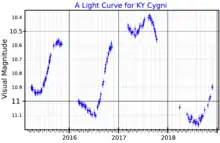
KY Cygni is a variable star with a large amplitude but no clear periodicity. At times, it varies rapidly, at others it is fairly constant for long periods.[10] The photographic magnitude range is given as 13.5 - 15.5,[5] while a visual range is 10.60 - 11.74.[3]
See also
References
- 1 2 3 4 5 Brown, A. G. A.; et al. (Gaia collaboration) (2021). "Gaia Early Data Release 3: Summary of the contents and survey properties". Astronomy & Astrophysics. 649: A1. arXiv:2012.01533. Bibcode:2021A&A...649A...1G. doi:10.1051/0004-6361/202039657. S2CID 227254300. (Erratum: doi:10.1051/0004-6361/202039657e). Gaia EDR3 record for this source at VizieR.
- 1 2 3 4 5 6 Mauron, N.; Josselin, E. (2011). "The mass-loss rates of red supergiants and the de Jager prescription". Astronomy and Astrophysics. 526: A156. arXiv:1010.5369. Bibcode:2011A&A...526A.156M. doi:10.1051/0004-6361/201013993. S2CID 119276502.
- 1 2 Alfonso-Garzón, J.; Domingo, A.; Mas-Hesse, J. M.; Giménez, A. (2012). "The first INTEGRAL-OMC catalogue of optically variable sources". Astronomy & Astrophysics. 548: A79. arXiv:1210.0821. Bibcode:2012A&A...548A..79A. doi:10.1051/0004-6361/201220095. S2CID 118428054.
- 1 2 White, N. M.; Wing, R. F. (1978). "Photoelectric two-dimensional spectral classification of M supergiants". Astrophysical Journal. 222: 209. Bibcode:1978ApJ...222..209W. doi:10.1086/156136.
- 1 2 3 KY Cyg, database entry, The combined table of GCVS Vols I-III and NL 67-78 with improved coordinates, General Catalogue of Variable Stars Archived 2017-06-20 at the Wayback Machine, Sternberg Astronomical Institute, Moscow, Russia. Accessed on line November 12, 2010.
- 1 2 3 4 5 6 7 Levesque, Emily M.; Massey, Philip; Olsen, K. A. G.; Plez, Bertrand; Josselin, Eric; Maeder, Andre; Meynet, Georges (2005). "The Effective Temperature Scale of Galactic Red Supergiants: Cool, but Not As Cool As We Thought". The Astrophysical Journal. 628 (2): 973–985. arXiv:astro-ph/0504337. Bibcode:2005ApJ...628..973L. doi:10.1086/430901. S2CID 15109583.
- ↑ Comerón, F.; Djupvik, A. A.; Schneider, N.; Pasquali, A. (October 2020). "The historical record of massive star formation in Cygnus". Astronomy & Astrophysics. 644: A62. arXiv:2009.12779. Bibcode:2020A&A...644A..62C. doi:10.1051/0004-6361/202039188. S2CID 221970180.
- ↑ Dorn-Wallenstein, Trevor Z.; Levesque, Emily M.; Neugent, Kathryn F.; Davenport, James R. A.; Morris, Brett M.; Gootkin, Keyan (2020). "Short Term Variability of Evolved Massive Stars with TESS II: A New Class of Cool, Pulsating Supergiants". The Astrophysical Journal. 902 (1): 24. arXiv:2008.11723. Bibcode:2020ApJ...902...24D. doi:10.3847/1538-4357/abb318. S2CID 221340538.
- 1 2 Messineo, M.; Brown, A. G. A. (2019). "A Catalog of Known Galactic K-M Stars of Class I Candidate Red Supergiants in Gaia DR2". The Astronomical Journal. 158 (1): 20. arXiv:1905.03744. Bibcode:2019AJ....158...20M. doi:10.3847/1538-3881/ab1cbd. S2CID 148571616.
- 1 2 Romano, G. (1969). "Researches with the Schmidt telescopes. III. Variable stars in the field of gamma Cygni". Memorie della Società Astronomia Italiana. 40: 375. Bibcode:1969MmSAI..40..375R.
- ↑ Hoffmeister, Cuno (1930). "Relative Koordinaten, Oerter und Karten neuer Veraenderlicher". Mitteilungen der Sternwarte zu Sonneberg. 17: 1. Bibcode:1930MiSon..17....1H.
- ↑ Ahnert, P.; Van Schewick, H.; Hoffmeister, C. (1941). "Die Veraenderlichen Sterne der noerdlichen Milchstrasse. Teil II". Kleine Veroeffentlichungen der Universitaetssternwarte zu Berlin Babelsberg. 6: 4.1. Bibcode:1941KVeBB...6....4A.
- ↑ Stickland, D. J. (1985). "IRAS observations of the cool galactic hypergiants". The Observatory. 105: 229. Bibcode:1985Obs...105..229S.
- ↑ Kochanek, C. S.; Shappee, B. J.; Stanek, K. Z.; Holoien, T. W. S.; Thompson, Todd A.; Prieto, J. L.; Dong, Subo; Shields, J. V.; Will, D.; Britt, C.; Perzanowski, D.; Pojmański, G. (October 2017). "The All-Sky Automated Survey for Supernovae (ASAS-SN) Light Curve Server v1.0". Publications of the Astronomical Society of the Pacific. 129 (980): 104502. arXiv:1706.07060. Bibcode:2017PASP..129j4502K. doi:10.1088/1538-3873/aa80d9.
External links
- http://jumk.de/astronomie/big-stars/ky-cygni.shtml
- http://www.astronomy.com/asy/default.aspx?c=a&id=2772
- List of Largest Stars Gets 3 New Chart Toppers, Robert Roy Britt, space.com, 10 January 2005. Accessed on line November 12, 2010.