| Luetzelburgia | |
|---|---|
Scientific classification  | |
| Kingdom: | Plantae |
| Clade: | Tracheophytes |
| Clade: | Angiosperms |
| Clade: | Eudicots |
| Clade: | Rosids |
| Order: | Fabales |
| Family: | Fabaceae |
| Subfamily: | Faboideae |
| Clade: | Vataireoids |
| Genus: | Luetzelburgia Harms (1922) |
| Type species | |
| Luetzelburgia auriculata (Allemão) Ducke | |
| Species[1][2][3][4][5] | |
| |
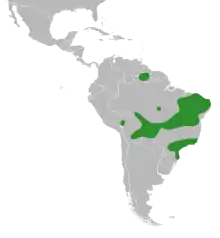 | |
| Range of the sucupiras and angelims (genus Luetzelburgia) | |
Luetzelburgia (common names include sucupira and angelim) is a genus of flowering plants in the legume family, Fabaceae. It includes 14 species of trees and shrubs native to Brazil, Bolivia, and Colombia. Typical habitat is seasonally-dry tropical lowland woodland and wooded grassland, and occasionally lowland rain forests.[5] The genus belongs to the subfamily Faboideae. It was traditionally assigned to the tribe Sophoreae, mainly on the basis of flower morphology;[6] recent molecular phylogenetic analyses assigned Luetzelburgia into an informal, monophyletic clade called the "vataireoids".[7][8] Keys for the different species of Luetzelburgia have been published.[1][4][9]
References
- 1 2 Cardoso DBOS; de Queiroz LP; de Lima HC. (2008). "Two New Species of Luetzelburgia (Leguminosae, Papilionoideae) from the Seasonally Dry Tropical Forests of Bolivia". Kew Bull. 63 (2): 289–300. doi:10.1007/s12225-008-9039-5. JSTOR 20649548.
- ↑ Cardoso DBOS; de Queiroz LP; de Lima HC. (2012). "Two New Species of Luetzelburgia (Leguminosae, Papilionoideae) from the Seasonally Dry Tropical Forests of Bolivia". Syst Bot. 37 (3): 677–683. doi:10.1600/036364412X648634.
- ↑ Cardoso DBOS; de Queiroz LP; de Lima HC. (2012). "Luetzelburgia amazonica (Leguminosae: Papilionoideae: Vataireoid clade), a new species from Brazilian Amazonia". Kew Bull. 67 (4): 833–836. doi:10.1007/s12225-012-9410-4.
- 1 2 Cardoso DBOS. (2012). "Capítulo 6: Taxonomic revision of Luetzelburgia (Leguminosae, Papilionoideae)" (PDF). Sistemática de Papilionoideae (Leguminosae): filogenia das linhagens basais e revisão de Luetzelburgia (Ph.D.). SiCAPES. Docket 28002016002P8.
- 1 2 Luetzelburgia Harms. Plants of the World Online. Retrieved 5 September 2023.
- ↑ Polhill RM. (1981). "Sophoreae". In Polhill RM, Raven PH (eds.). Advances in Legume Systematics, Part 1. Royal Botanic Gardens, Kew. pp. 213–230. ISBN 9780855212247.
- ↑ Cardoso D, Pennington RT, de Queiroz LP, Boatwright JS, Van Wyk BE, Wojciechowskie MF, Lavin M (2013). "Reconstructing the deep-branching relationships of the papilionoid legumes" (PDF). S Afr J Bot. 89: 58–75. doi:10.1016/j.sajb.2013.05.001.
- ↑ Cardoso D, de Queiroz LP, de Lima HC, Suganuma E, van den Berg C, Lavin M (2013). "A molecular phylogeny of the vataireoid legumes underscores floral evolvability that is general to many early-branching papilionoid lineages". Am J Bot. 100 (2): 403–21. doi:10.3732/ajb.1200276. PMID 23378491.
- ↑ Cardoso DBOS; de Queiroz LP; de Lima HC. (2014). "A taxonomic revision of the South American papilionoid genus Luetzelburgia (Fabaceae)". Bot J Linn Soc. 175 (3): 328–375. doi:10.1111/boj.12153.
This article is issued from Wikipedia. The text is licensed under Creative Commons - Attribution - Sharealike. Additional terms may apply for the media files.