
Menacuddle is a historic place, holy well and wooded area in St Austell, Cornwall, UK.[1]
The holy well was built in the 15th century and restored by Admiral Sir Charles John Graves-Sawle shortly after the First World War in memory of his son who was killed in action.[2] It is a popular spot with ramblers.[3] Its name is recorded as Menequidel in 1250 and Menedcudel in 1284 and comes from the Old Cornish mened and cuydel and it means hillside with a small wood. The name does not include a saint's name, and there was no St Guidel.[4] The site has also been known as Pinni-menny.[5]
It is said that if a person drops a pin into the well and makes a wish, that wish will be granted.[5] The woods have a reputation for being haunted, with sightings of a "huge black beast" there.[6]
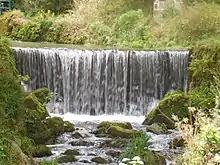
The site is a monument scheduled under the Ancient Monuments and Archaeological Areas Act 1979, NHLE list number 1019163.[7]
References
- ↑ "Menacuddle Well, Menacuddle Woods, St Austell · cornishmemory.com". cornishmemory.com. Retrieved 8 October 2017.
- ↑ "'Beast' spotted at holy well | St Austell Voice". www.staustellvoice.co.uk. Retrieved 8 October 2017.
- ↑ "St Austell Walk". Retrieved 8 October 2017.
- ↑ Craig Weatherhill, Placenames in Cornwall and Scilly 2005, page 122.
- 1 2 Fred W. P. Jago, The Ancient Language and the Dialect of Cornwall, 1882
- ↑ Millar, Joey (11 May 2016). "Walker finds HUMAN REMAINS in eerie wood haunted by BLACK BEAST". Express.co.uk. Retrieved 8 October 2017.
- ↑ Historic England. "Menacuddle Well, Treverbyn (1019163)". National Heritage List for England. Retrieved 8 October 2017.
50°20′45″N 4°47′46″W / 50.3457°N 4.7960°W