| |||
| Names | |||
|---|---|---|---|
| IUPAC name
Oxoborinic acid | |||
| Other names
Metaboric acid | |||
| Identifiers | |||
3D model (JSmol) |
|||
| ChemSpider | |||
| ECHA InfoCard | 100.033.313 | ||
| EC Number |
| ||
| 121829 | |||
PubChem CID |
|||
CompTox Dashboard (EPA) |
|||
| |||
| |||
| Properties | |||
| B3H3O6 | |||
| Molar mass | 131.45 g·mol−1 | ||
| Appearance | white solid | ||
| Density | 1.784 g cm−3 | ||
| Melting point | 176 °C (349 °F; 449 K) | ||
| Acidity (pKa) | 9.236 | ||
| Conjugate base | Metaborate | ||
| Structure | |||
| trigonal at B | |||
| Hazards | |||
| GHS labelling:[1] | |||
 | |||
| Warning | |||
| H315, H319, H335 | |||
| P261, P305+P351+P338 | |||
Except where otherwise noted, data are given for materials in their standard state (at 25 °C [77 °F], 100 kPa).
Infobox references | |||

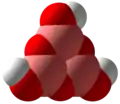


Metaboric acid is the name for a family of inorganic compounds with the same empirical formula HBO2.[2] that differ in their molecular structure. They are colourless water-soluble solids formed by the dehydration or decomposition of boric acid.
Metaboric acid is formally the parent acid of the metaborate anions.
Structure
The main forms of metaboric acid are:
- Modification III, or trimeric, with the molecular formula H3B3O6. The molecule has C3h symmetry, with a six-member ring of alternating boron and oxygen atoms at the core, with OH groups attached to the borons. The crystal structure is orthorhombic with a sheet-like structure, similar to that of boric acid itself.[3] It is obtained by heating orthoboric acid at 80-100 °C, with loss of water:[3]
- 3 B(OH)3 → (BOH)3O3 + 3 H2O
- Modification II. A polymer with structure similar to modification III, except that the rings are connected and 1/3 of the boron centres are tetrahedral. The molecular formula is therefore HO[−B(BOH)2O3O−]nH The crystal structure is monoclinic.[4] This form has a higher melting point (201 °C) and density (2.045 g/cm3) It is obtained by heating the trimeric form at 130-140 °C in a sealed ampoule (to prevent dehydration), orthorhombic metaboric acid converts to the monoclinic form (II):[4]

Reactions
When heated above about 170 °C, metaboric acid dehydrates, forming tetraboric acid, also called pyroboric acid (H2B4O7):[6][7]
- 4 HBO2 → H2B4O7 + H2O
Metaborates
Metaborates are derivatives of BO2−. Like metaboric acid, the metaborates exist with disparate structures. Examples are sodium and potassium metaborates, salts formed by deprotonation of orthorhombic metaboric acid containing the cyclic B3O63− ion and calcium metaborate, Ca(BO2)2, which contains the chain polymeric ion (BO2−)n.[2]
References
- ↑ GHS: Sigma-Aldrich 413453
- 1 2 Greenwood, N. N.; & Earnshaw, A. (1997). Chemistry of the Elements (2nd Edn.), Oxford:Butterworth-Heinemann. ISBN 0-7506-3365-4.
- 1 2 H. J. Becher "Metaboric Acid" Handbook of Preparative Inorganic Chemistry, 2nd Ed. Edited by G. Brauer, Academic Press, 1963, NY. Vol. 1. p. 791.
- 1 2 W. H. Zachariasen "The crystal structure of monoclinic metaboric acid" Acta Crystallogr. 1963, vol. 16, pp. 385-389. doi:10.1107/S0365110X6300102X
- 1 2 Freyhardt, C. C.; Wiebcke, M.; Felsche, J. (2000). "The monoclinic and cubic phases of metaboric acid (precise redeterminations)". Acta Crystallogr C. 56 (3): 276–278. doi:10.1107/S0108270199016042. PMID 10777918.
- ↑ Gurwinder Kaur, Shagun Kainth, Rohit Kumar, Piyush Sharma and O. P. Pandey (2021): "Reaction kinetics during non-isothermal solid-state synthesis of boron trioxide via boric acid dehydration." Reaction Kinetics, Mechanisms and Catalysis, volume 134, pages 347–359. doi:10.1007/s11144-021-02084-8
- ↑ Siavash Aghili, Masoud Panjepour, and Mahmood Meratian (2018): "Kinetic analysis of formation of boron trioxide from thermal decomposition of boric acid under non-isothermal conditions." Journal of Thermal Analysis and Calorimetry, volume 131, pages 2443–2455. doi:10.1007/s10973-017-6740-3