Mitoji Yabunaka | |
|---|---|
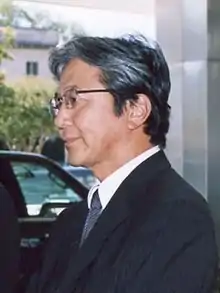 Mitoji Yabunaka in 2005 | |
| Vice-Minister for Foreign Affairs | |
| Assumed office 2007 | |
| Preceded by | Tsuneo Nishida |
| Director-General of the Asian and Oceanian Affairs Bureau | |
| In office 2002–2005 | |
| Preceded by | Hitoshi Tanaka |
Mitoji Yabunaka (薮中 三十二, Yabunaka Mitoji, born January 23, 1948) is the current Japanese Vice-Minister for Foreign Affairs[1] in charge of administration.[2] Prior to his current position, Yabunaka served as Ministry of Foreign Affair's Asian and Oceanian Affairs Bureau Director-General.[3][4] He has been a diplomat for nearly forty years.[5]
Diplomacy
Before entering government service, Yabunaka was a senior researcher at the International Institute for Strategic Studies from 1990-1991.[6] In 1998, Yabunaka became Consul General of Japan in Chicago US, and visited the country on several occasions.[5]
Yabunaka has represented Japan on a number of occasions, and has negotiated trade deals with the United States, Australia,[7] and Indonesia.[8] He has had contact with a number of United States diplomats, including hosting current United States Ambassador to Japan John Roos shortly following Roos' appointment.[9] During the first, second, and third rounds of the Six-party talks, Yabunaka represented Japan as chief delegate.[10] The Japanese government also sent Yabanuka as a delegate to China to discuss issues of natural gas reserves under the East China Sea.[11]
He handled Myanmar relations during the Kenji Nagai shooting incident, demanding an investigation and challenging governmental claims.[12] Yabunaka replaced Toshiyuki Takano as Director-General of Asian and Oceanian Affairs Bureau in 2002.[13] In 2008, Yabunaka held talks with South Korean Ambassador Kwon Chul Hyun over disputed islets in the Sea of Japan.[14]
Notes
References

- Cameron, Deborah (14 September 2005). "Japan in the market for free trade pact". The Sydney Morning Herald. Fairfax Media. Retrieved 15 September 2009.
- "China, Japan fail again to solve gas issue". The China Post. 25 February 2008. Retrieved 15 September 2009.
- "Foreign Ministry to cooperate with DPJ in investigation on secret nuke accord with U.S." The Mainichi Daily News. Retrieved 15 September 2009.
- Funabashi, Yōichi (2007). The Peninsula Question: a Chronicle of the Second Korean Nuclear Crisis. Washington, D.C.: Brookings Institution Press. ISBN 978-0-8157-3010-1. Retrieved 15 September 2009.
- Hongo, Jun (21 August 2009). "Roos gets to work, meets vice minister". The Japan Times. Retrieved 15 September 2009.
- "Indonesia, Japan resume free trade negotiations". The Jakarta Post. 16 September 2004. Archived from the original on 22 June 2009. Retrieved 15 September 2009.
- "9 Oct 08 - Discussion Meeting - Mitoji Yabunaka". International Institute for Strategic Studies. 2009. Retrieved 16 September 2009.
- "Japanese delegation arrives in Beijing for six-party talks". Xinhua News Agency. 25 August 2003. Archived from the original on August 29, 2003. Retrieved 15 September 2009.
- Jiji Press (4 December 2002). "Japan to Promote Key N. Korea Negotiator Tanaka". Asia Africa Intelligence Wire. Retrieved 15 September 2009.
- Kyodo News (3 October 2007). "Reporter's slaying was accidental: Myanmar". The Japan Times. Retrieved 15 September 2009.
- McDonald, Joe (25 February 2004). "China Plays Diplomat in Nuclear Dispute". The Washington Post. Retrieved 15 September 2009.
- "Mofa Info". Ministry of Foreign Affairs of Japan. 2009. Retrieved 15 September 2009.
- Potter, Dean (14 June 2000). "Consul General Mitoji Yabunaka: Building Good Relationships". Asian Pages. Archived from the original on 26 October 2012. Retrieved 15 September 2009.
- "S Korean ambassador protests over Japan's claim of disputed islets". Xinhua News Agency. 15 July 2008. Archived from the original on November 2, 2012. Retrieved 15 September 2009.