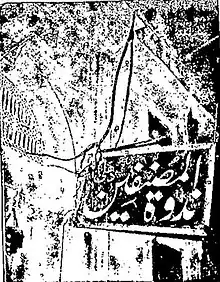
 Nadwatul Musannifeen during 1987 | |
| Status | defunct |
|---|---|
| Founded | 1938 |
| Founders | |
Nadwatul Musannifeen (English: Council of Writers) was an academic research institution and publishing house in Delhi. The institution was co-founded by scholars including Atiqur Rahman Usmani, Hamid al-Ansari Ghazi, Hifzur Rahman Seoharwi and Saeed Ahmad Akbarabadi in 1938.
History
Nadwatul Musannifeen was established by Atiqur Rahman Usmani, Hamid al-Ansari Ghazi, Hifzur Rahman Seoharwi and Saeed Ahmad Akbarabadi in 1938.[1] Originally set up in Karol Bagh, the institution suffered losses during 1947 riots. It was moved to nearby Jama Masjid, Delhi post the Partition of India by Atiqur Rahman Usmani.[2]
The institution has published books on issues related to religion, history, culture and theology.[3] The institution published Burhan, a magazine that is regarded as the best Islamiyat magazine after the Al-Ma'ārif of Shibli Academy.[4]
Associated scholars
Publications
The Nadwatul Musannifeen has published more than 250 books including:[5]
| Book | Author | References |
|---|---|---|
| Akhbār-ut-Tanzeel | Ismail Sambhali | [6] |
| Al-Fauzul Kabīr fi Usūl it-Tafsīr (Urdu translation) | Shah Waliullah, Abdul Rasheed Ansari | [7] |
| Al-Basā'ir | Abd al-Hayy Farooqi | [8] |
| Tadween-e-Qur'an | Manazir Ahsan Gilani | [9] |
| Tafsir al-Mazhari | Qadi Thanaullah Panipati | [10] |
| Fehm-e-Qur'an | Saeed Ahmad Akbarabadi | [11] |
| Lughāt-ul-Qur'ān | Abdul Rasheed Nomani | [12][13] |
| Hikmat al-Qur'ān | Muhammad Taqi Amini | [14] |
| Qasas al-Qur'ān | Hifzur Rahman Seoharwi | [15] |
| Book | Author | References |
|---|---|---|
| Tarjuman al-Sunnah | Badre Alam Merathi | [16] |
| Uswa-e-Hasanah | Zafeeruddin Miftahi | [17] |
| Kitab-e-Hadees | Minnatullah Rahmani | [18] |
| Hadees ka dirāyati meyār | Muhammad Taqi Amini | [19] |
| Ma'āsr-o-Ma'ārif | Qazi Athar Mubarakpuri | [20] |
| Book | Author | References |
|---|---|---|
| Āsār-o-Akhbār | Qazi Athar Mubarakpuri | [21] |
| Tārikh-e-Millat (volume 1 to 3) | Zayn al-Abidin Sajjad Meerthi | [22] |
| Tārikh-e-Millat (volume 4 to volume 11) | Intizamullah Shehbai | [23] |
| Tārikh-e-Tabari ke Ma'ākhaz ka tanqīdi mutāla | Nisar Ahmed Faruqi | [24] |
| Tārikhi Maqālāt | K. A. Nizami | [25] |
| Tahzeeb ki tashkīl-e-jadīd | Muhammad Taqi Amini | [26] |
| MusalmānoN ki firqa-bandiyoN ka afsāna | Manazir Ahsan Gilani | [27] |
| Sarkashi-e-Zila Bijnor | Syed Ahmad Khan | [28] |
| Ulama-e-Hind ka shāndār māzi | Muhammad Miyan Deobandi | [29] |
| Hindustān mai ArboN ki hakūmateN | Qazi Athar Mubarakpuri | [30] |
| Book | Author | References |
|---|---|---|
| Imdād al-Mushtāq | Ashraf Ali Thanwi | [31] |
| Tārikh Mashāyikh-e-Chisht | K. A. Nizami | [32] |
| Book | Author | References |
|---|---|---|
| Islām ka Nizām-e-Hukūmat | Hamid al-Ansari Ghazi | [33] |
| Islām ka nizām-e-masājid | Zafeeruddin Miftahi | [34] |
| Urooj-o-Zawāl ka ilāhi nizām | Muhammad Taqi Amini | [35] |
| Hayāt Abd al-Hayy | Abul Hasan Ali Hasani Nadwi | [36] |
| Tālimāt-e-Islāmi awr Masīhi aqwām | Muhammad Tayyib Qasmi | [37] |
Legacy
At the Jamia Millia Islamia, Abdul Waris Khan wrote a doctoral thesis entitled Islāmi Uloom mai Nadwatul Musannifeen ki Khidmāt: Ek mutāla, (transl. The contribution of Nadwatul Musannifeen in Islamic studies: A study).[38]
References
- ↑ Nayab Hasan Qasmi. Darul Uloom Deoband Ka Sahafati ManzarNama. Idara Tehqeeq-e-Islami, Deoband. pp. 176, 198.
- ↑ Meerthi, Zayn al-Abidin Sajjad. "Mufti Saheb Ki Zindagi Ke Chand Goshey". In Mehdi, Jameel (ed.). Mufakkir-e-Millat Number, Burhan [Few glimpses from the life of Mufti] (in Urdu) (November 1987 ed.). Delhi: Nadwatul Musannifeen. p. 46.
- ↑ Paul Jackson (1988). The Muslims of India: Beliefs and Practices. Delhi: Islamic Studies Association. p. 247. Retrieved 3 January 2021.
- ↑ Sajjad Zaheer (2006). The Light, A History of the Movement for Progressive Literature in the Indo-Pakistan Subcontinent: a Translation of Roshnai. Translated by Amina Azfar. Oxford University Press. p. 233.
- ↑ "Educationists mourn the death of Prof Fariq". The Milli Gazette. Retrieved 5 January 2021.
- ↑ Khan 1999, p. 32.
- ↑ Khan 1999, p. 33.
- ↑ Khan 1999, p. 34.
- ↑ Khan 1999, p. 35.
- ↑ Khan 1999, p. 36.
- ↑ Khan 1999, p. 40.
- ↑ Khan 1999, p. 45.
- ↑ Bilaal Abdul Hayy Hasani Nadvi (4 December 2020). "Maulana Abdur Rasheed Nomani, Great Muhaddith & Research Scholar". islaminsight.org. Translated by M. Afzal Hoosen Elias. Retrieved 5 January 2021.
- ↑ Khan 1999, p. 49.
- ↑ Khan 1999, p. 50.
- ↑ Khan 1999, p. 62–71.
- ↑ Khan 1999, p. 72.
- ↑ Khan 1999, p. 73.
- ↑ Khan 1999, p. 84.
- ↑ Khan 1999, p. 87.
- ↑ Khan 1999, p. 99.
- ↑ Khan 1999, p. 106–111.
- ↑ Khan 1999, p. 87–124.
- ↑ Khan 1999, p. 127.
- ↑ Khan 1999, p. 129.
- ↑ Khan 1999, p. 132.
- ↑ Khan 1999, p. 169.
- ↑ Khan 1999, p. 189.
- ↑ Khan 1999, p. 192.
- ↑ Khan 1999, p. 194.
- ↑ Khan 1999, p. 209.
- ↑ Khan 1999, p. 212.
- ↑ Khan 1999, p. 250.
- ↑ Khan 1999, p. 252.
- ↑ Khan 1999, p. 258.
- ↑ Khan 1999, p. 280.
- ↑ Khan 1999, p. 293.
- ↑ Abdul Waris Khan. "Preface By Shees Ismail Azmi". Islāmi Uloom mai Nadwatul Musannifeen ki Khidmāt: Ek mutāla [The contribution of Nadwatul Musannifeen in Islamic studies: A study]. New Delhi: Islamic Book Foundation. p. 7. Retrieved 5 January 2021.
Bibliography
- Khan, Abdul Waris (1999). Islāmi Uloom mai Nadwatul Musannifeen ki Khidmāt: Ek mutāla [The contribution of Nadwatul Musannifeen in Islamic studies: A study]. New Delhi: Islamic Book Foundation.
External links
- Nadwatul Musannifeen, Delhi in Encyclopaedia of India.