| Oenothera macrocarpa | |
|---|---|
 | |
Scientific classification  | |
| Kingdom: | Plantae |
| Clade: | Tracheophytes |
| Clade: | Angiosperms |
| Clade: | Eudicots |
| Clade: | Rosids |
| Order: | Myrtales |
| Family: | Onagraceae |
| Genus: | Oenothera |
| Species: | O. macrocarpa |
| Binomial name | |
| Oenothera macrocarpa | |

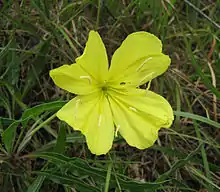
Oenothera macrocarpa (syn. Oenothera missouriensis), the bigfruit evening primrose,[1] Ozark sundrops,[2] Missouri evening primrose,[3] or Missouri primrose,[4] is a species of flowering plant in the evening primrose family Onagraceae, native to northeast Mexico and the south-central United States, where it is found in calcareous prairies and limestone outcrops.[5]
Description
This herbaceous perennial produces a red stem up to 46 cm (18 in) in height.[6] The plant can sprawl along the ground up to 0.6 m (2 ft).[4] Leaves are long and narrow, about 15 cm (6 in) long by 3 cm (1 in) across, and are densely crowded in an alternate arrangement along the stem.[6] They have either smooth margins or broadly spaced teeth and are hairy.[7]
The large flowers, up to 13 cm (5 in) across, are cup shaped with four petals, canary yellow, and have a mild fragrance. They are produced in great numbers from early to mid summer. The flowers last for one day, opening in the evening and closing the following morning.[6] The seed pods are 4-winged and 52–75 mm (2–3 in) long.[7]
Taxonomy
There are five commonly accepted varieties.[8] These are:
- O. macrocarpa var. fremontii - restricted to Kansas and southern Nebraska[9]
- O. macrocarpa var. incana - southern Kansas, western Oklahoma and northern Texas
- O. macrocarpa var. macrocarpa - the most widespread; Texas to the Ozark Mountains, with disjunct populations in Tennessee's Nashville Basin[10]
- O. macrocarpa var. mexicana - known only from Coahuila, Mexico[11]
- O. macrocarpa var. oklahomensis - southern Kansas, Oklahoma and northern Texas
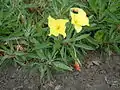 O. m. subsp. macrocarpa
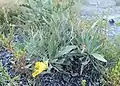 O. m. subsp. incana
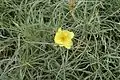 O. m. subsp. fremontii
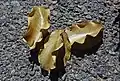 Fruit
Fruit
Etymology
The genus name Oenothera is from the Greek for "wine-scented". The specific epithet macrocarpa is also from the Greek, meaning "large fruited".[12]
Distribution and habitat
Oenothera macrocarpa is native to Arkansas, Illinois, Kansas, Missouri, Nebraska, Oklahoma, Tennessee, Texas, and northeast Mexico.[13] Habitats include limestone outcrops, glades, bluffs, rocky prairies, quarries, and roadsides.[7]
Ecology
The flowers are pollinated by night-flying moths, such as sphinx moths (Sphingidae).[6]
Uses
The seed pods are often used in flower arrangements. This plant is also grown in gardens for its flowers.[14][15] It is suitable as a groundcover in poor, stony soil which does not become waterlogged in winter, in full sun. It has gained the Royal Horticultural Society’s Award of Garden Merit.[2][16]
References
- ↑ USDA, NRCS (n.d.). "Oenothera macrocarpa". The PLANTS Database (plants.usda.gov). Greensboro, North Carolina: National Plant Data Team. Retrieved 29 January 2016.
- 1 2 "RHS Plantfinder - Oenothera macrocarpa". Retrieved 14 April 2018.
- ↑ "NatureServe Explorer 2.0". explorer.natureserve.org.
- 1 2 "Oenothera macrocarpa; Missouri Primrose". Oenothera macrocarpa; Missouri Primrose.
- ↑ Shinners and Mahler's Illustrated Flora of North Central Texas Online
- 1 2 3 4 "Missouri Evening Primrose (Oenothera macrocarpa)". www.illinoiswildflowers.info.
- 1 2 3 "Oenothera macrocarpa page". www.missouriplants.com.
- ↑ "Oenothera macrocarpa Nutt. | Plants of the World Online | Kew Science". Plants of the World Online.
- ↑ USDA, NRCS (n.d.). "Oenothera macrocarpa". The PLANTS Database (plants.usda.gov). Greensboro, North Carolina: National Plant Data Team. Retrieved 18 January 2017.
- ↑ Chester, Edward (2015). Guide to the Vascular Plants of Tennessee.
- ↑ Wagner, Warren; Hoch, Peter; Raven, Peter (2007). "Revised Classification of the Onagraceae". Systematic Botany Monographs. 83. JSTOR i25027967.
- ↑ Denison, Edgar (2017). Missouri Wildflowers (Sixth ed.). Conservation Commission of the State of Missouri. p. 137. ISBN 978-1-887247-59-7.
- ↑ "Oenothera macrocarpa Nutt. | Plants of the World Online | Kew Science". Plants of the World Online.
- ↑ Missouri Botanical Garden
- ↑ "Perennial Resource: Oenothera missouriensis". Archived from the original on 2012-03-17. Retrieved 2011-03-15.
- ↑ "AGM Plants - Ornamental" (PDF). Royal Horticultural Society. July 2017. p. 69. Retrieved 14 April 2018.