| Revia | |||||||
|---|---|---|---|---|---|---|---|
| |||||||
| cantillation | |||||||
| Sof passuk | ׃ | paseq | ׀ | ||||
| etnakhta/atnakh | ֑ | segol | ֒ | ||||
| shalshelet | ֓ | zaqef qaton | ֔ | ||||
| zaqef gadol | ֕ | tifcha/tarkha | ֖ | ||||
| rivia/ravia’ | ֗ | zarqa | ֘ | ||||
| pashta | ֙ | yetiv | ֚ | ||||
| tevir | ֛ | geresh/gerish | ֜ | ||||
| geresh muqdam | ֝ | gershayim/shenei gerishin | ֞ | ||||
| karnei pharah | ֟ | telisha gedola/talsha | ֠ | ||||
| pazer (gadol) | ֡ | atnah hafukh | ֢ | ||||
| munakh/shofar holekh | ֣ | mahapakh/shofar mehupakh | ֤ | ||||
| merkha/ma’arikh | ֥ | merkha kefula/terei ta’amei | ֦ | ||||
| darga | ֧ | qadma | ֨ | ||||
| telisha qetana/tarsa | ֩ | yerah ben yomo | ֪ | ||||
| ole | ֫ | illuy | ֬ | ||||
| dehi | ֭ | zinor | ֮ | ||||
Revia (רְבִיעַ, [rəviaʕ]) is a cantillation mark commonly found in the Torah, Haftarah, and other biblical texts.
It is commonly explained as being the Aramaic equivalent of Hebrew רְבִיעִי Revi'i, meaning 'fourth' or 'quarter'.[1], and for that reason is sometimes called Revi'i. However, this is probably a folk etymology: the more likely meaning in Aramaic is "crouching" or "lying", referring to its position vertically above the word.[2]
Revia is considered to have medium strength. It is stronger than a Pashta or Tevir, but weaker than a Zakef or Tifcha.[3]
Revia can occur either by itself, or following one or two Munachs. When there are two Munachs prior to a Revia, the first Munach has a long melody, and the second one is short. When there is one Munach, it is short.
Based on its translation as fourth, in printed texts it is represented by a diamond-shaped mark. However in manuscripts it is just a dot.[4]
Total occurrences
| Book | Number of appearances |
|---|---|
| Torah | 2430[5] |
| Genesis | 610[5] |
| Exodus | 504[5] |
| Leviticus | 312[5] |
| Numbers | 497[5] |
| Deuteronomy | 507[5] |
| Nevi'im | 2239[6] |
| Ketuvim | 1672[6] |
Melody
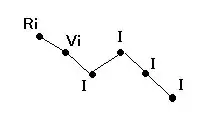
The Rivia is read in a slow, downward tone, with a pause in the middle breaking upward.
References
- ↑ Buhl, Dr. Frants (2021). Wilhelm Gesenius' Hebräisches und aramäisches Handwörterbuch [Hebrew and Aram concise dictionary by Wilhelm Gesenius] (in German) (17 ed.). Berlin / Heidelberg: Springer. p. 742. ISBN 978-3-642-94264-8.
- ↑ Lier, Gudrun, "The Revia in the Context of Decoding Masoretic Accents", Journal of Semitics, 2011, Vol 21/1, pp. 28-51.
- ↑ Chanting the Hebrew Bible By Joshua R. Jacobson, page 102
- ↑ The Art of Cantillation, Volume 2: A Step-By-Step Guide to Chanting Haftarot ... By Marshall Portnoy, Josée Wolff, page 43
- 1 2 3 4 5 6 Concordance of the Hebrew accents in the Hebrew Bible: Concordance ..., Volume 1 By James D. Price, page 6
- 1 2 Concordance of the Hebrew accents in the Hebrew Bible: Concordance ..., Volume 1 By James D. Price, page 5