| Ryōsen-ji | |
|---|---|
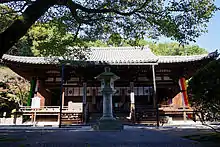 Ryōsen-ji Hondō (1283), a National Treasure | |
| Religion | |
| Affiliation | Ryōsen-ji Shingon Buddhism |
| Deity | Yakushi Nyorai |
| Location | |
| Location | 3879 Nakamachi, Nara 631-0052 |
| Country | Japan |
| Geographic coordinates | 34°40′24″N 135°44′33″E / 34.673448°N 135.742401°E |
| Architecture | |
| Completed | 736 |
| Website | |
| Ryōsen-ji | |
Ryōsen-ji (霊山寺) is a Buddhist temple in Nara, Japan. Founded in the eighth century, the Hondō is a National Treasure and a number of other buildings and temple treasures have been designated Important Cultural Properties.
History
In the late seventh century Ono no Tobito erected a set of public baths on Mount Tomi outside Nara and enshrined an image of Yakushi. In 734 Emperor Shōmu instructed Gyōki to erect a hall on the site, and two years later the Indian monk Bodhisena, noticing a resemblance to the Vulture Peak, founded the Ryōsen-ji. The Hondō was rebuilt in 1283. Toyotomi Hideyoshi granted the temple lands valued at a hundred koku. In the Meiji period many of the monk's quarters were abandoned and over two hundred images were burned. Restored in 1940, the temple has been revived.[1]
Buildings
- Hondō (1283), 5x6 bay, irimoya-zukuri, tiled roof (National Treasure)[2][3]
- Niōmon (1516), three bay, one door (Important Cultural Property)[4]
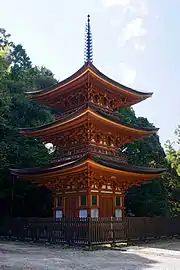
- Three storey pagoda (1356), hinoki bark roof (ICP)[5][6]
- Shōrō (mid-Muromachi period), single bay, irimoya-zukuri, hinoki bark roof (ICP)[7][8]
Treasures
- Wall painting inside the three-storey pagoda (late Kamakura period to Nambokuchō period) (ICP)[9]
- Seated statue of Yakushi Nyorai (ICP)[10]
- Statues of Nikkō Bosatsu and Gakkō Bosatsu (ICP)[11]
- Zushi (1285) (ICP)[12]
- Statues of Jūni Shinshō (Kamakura period) (ICP)[13]
- Plaque of Buddha triad (Hakuhō period) (ICP)[14]
- Seated statue of Amida Nyorai (twelfth century) (ICP)[15]
- Seated statue of Dainichi Nyorai (late Heian period) (ICP)[16]
- Statue of Jūichimen Kannon (early Heian period) (ICP)[17]
- Statue of Bishamonten (twelfth century) (ICP)[18]
- Statues of Jikokuten and Bishamonten (late Kamakura period) (ICP)[19]
- Statue of Jizō Bosatsu (1256) (ICP)[20]
- Pendant disc of Yakushi triad (1366) (ICP)[21]
- Pendant disc (Kamakura period) (ICP)[22]
- Seated statue of Gyōki[23]
- Seated statue of Bodhisena[24]
Jūrokusho Jinja
Jūrokusho Jinja (十六所神社) is now an independent shrine, but before the Meiji period served Ryōsen-ji in a tutelary capacity.[25] The Honden (1384) and subordinate Sumiyoshi Jinja Honden and Ryūō Jinja Honden (both 1386) have been designated Important Cultural Properties.[26][27][28]
See also
References
- ↑ "The Founding and History of the Temple". Ryōsenji. Archived from the original on 25 May 2011. Retrieved 19 April 2011.
- ↑ "Database of Registered National Cultural Properties". Agency for Cultural Affairs. Retrieved 19 April 2011.
- ↑ "Hondō". Ryōsenji. Archived from the original on 28 August 2009. Retrieved 19 April 2011.
- ↑ "Database of Registered National Cultural Properties". Agency for Cultural Affairs. Retrieved 19 April 2011.
- ↑ "Database of Registered National Cultural Properties". Agency for Cultural Affairs. Retrieved 19 April 2011.
- ↑ "Sanjūnotō". Ryōsenji. Archived from the original on 25 May 2011. Retrieved 19 April 2011.
- ↑ "Database of Registered National Cultural Properties". Agency for Cultural Affairs. Retrieved 19 April 2011.
- ↑ "Shōrō". Ryōsenji. Archived from the original on 25 May 2011. Retrieved 19 April 2011.
- ↑ "Wall painting inside the three-storey pagoda". Ryōsenji. Archived from the original on 25 May 2011. Retrieved 19 April 2011.
- ↑ "Yakushi Nyorai". Ryōsenji. Archived from the original on 25 May 2011. Retrieved 19 April 2011.
- ↑ "Nikkō & Gakkō Bosatsu". Ryōsenji. Archived from the original on 25 May 2011. Retrieved 19 April 2011.
- ↑ "Zushi". Ryōsenji. Archived from the original on 25 May 2011. Retrieved 19 April 2011.
- ↑ "Jūni Shinshō". Ryōsenji. Archived from the original on 25 May 2011. Retrieved 19 April 2011.
- ↑ "Buddha triad". Ryōsenji. Archived from the original on 26 May 2009. Retrieved 19 April 2011.
- ↑ "Yakushi Nyorai". Ryōsenji. Archived from the original on 25 May 2011. Retrieved 19 April 2011.
- ↑ "Dainichi Nyorai". Ryōsenji. Archived from the original on 26 May 2009. Retrieved 19 April 2011.
- ↑ "Jūichimen Kannon". Ryōsenji. Archived from the original on 25 May 2011. Retrieved 19 April 2011.
- ↑ "Bishamonten". Ryōsenji. Archived from the original on 25 May 2011. Retrieved 19 April 2011.
- ↑ "Jikokuten & Bishamonten". Ryōsenji. Archived from the original on 25 May 2011. Retrieved 19 April 2011.
- ↑ "Jizō Bosatsu". Ryōsenji. Archived from the original on 25 May 2011. Retrieved 19 April 2011.
- ↑ "Yakushi triad". Ryōsenji. Archived from the original on 25 May 2011. Retrieved 19 April 2011.
- ↑ "Pendant disc". Ryōsenji. Archived from the original on 26 May 2009. Retrieved 19 April 2011.
- ↑ "Gyōki Bosatsu". Ryōsenji. Archived from the original on 26 May 2009. Retrieved 19 April 2011.
- ↑ "Bodhisena". Ryōsenji. Archived from the original on 26 May 2009. Retrieved 19 April 2011.
- ↑ "Jūrokusho Jinja". Ryōsenji. Archived from the original on 26 May 2009. Retrieved 19 April 2011.
- ↑ "Database of Registered National Cultural Properties" (in Japanese). Agency for Cultural Affairs. Retrieved 20 April 2011.
- ↑ "Database of Registered National Cultural Properties" (in Japanese). Agency for Cultural Affairs. Retrieved 20 April 2011.
- ↑ "Database of Registered National Cultural Properties" (in Japanese). Agency for Cultural Affairs. Retrieved 20 April 2011.
External links

- (in English) Ryōsenji - Founding & History
- (in Japanese) Ryōsenji homepage