Sadiq Ahangaran صادق آهنگران | |
|---|---|
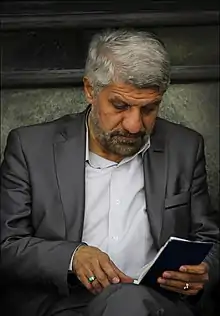 Ahangaran in 2015 looking through a book of poems | |
| Background information | |
| Birth name | Muhamad Sadiq Ahangari |
| Also known as | Sadiq Ahangaran |
| Born | 2 February 1957 Dezful, Islamic republic of Iran |
| Genres | Zamine |
| Years active | Eight years in the Islamic Revolutionary Guard Corps |
Muhamad Sadiq Ahangaran (Persian: محمد صادق آهنگران, romanized: Muḥamad Ṣādiq Ahangāran; born 2 February 1957 A.D./1336 A.H. in Dezful),[1] commonly known as Haj Sadiq Ahangaran or just Ahangaran,[2][3][4][5] is an Iranian Zaker (Islamic Singer-songwriter of Dhikr), former Soldier of the Iran–Iraq War and leading member of the Islamic Revolution Committee.[6][7][8][9]
Life

Ahangaran's complete first name is Muhamad Sadiq, his previous surname having been Ahangari. Moreover, while he was raised in Ahwaz, he is originally from the city of Dezful.[10][11] Ahangaran embarked his Maddahi since his teenage period by singing (religiously/sorrowfully) in Hay'ats which are religious foundation holding mourning ceremonies. He got married when he was at the age of 23. His offspring are included three sons and a daughter.[12]
Sadiq Ahangaran used to recite prayer supplications (between Salah), Du'a Kumayl, and also singing (religiously/sadly) in Sineh-Zani besides singing during the operations – in Iran–Iraq War.[12] His first Noha which was shown live on television, was the called "Ey Shahidan Beh Khoon-Ghaltaneh Khuzestan Durood" based on a poem originally by Habibullah Moalemi, Ahangaran recited it in Jamaran by the attendance of Sayyid Ruhollah Khomeini, which was run several times on Iranian TV.[12][13]
Works
Among the albums of Sadiq Ahangaran are as follows:
- Daghe Azali (eternal bereaved)
- Dashte Karbala (The plain of Karbala)
- Atash wa Aatash (Fire and thirst)
- Tak Taranehha (single songs)[14]
Amongst the Nohas of Sadiq Ahangaran are as follows:[15][16][17]
- Khuzestan
- Koo Shahidan ma (Where are our martyrs?)
- Ba nawaye Karavan (with the air of the caravan)
- Karbala Montazere Mast, bia ta Berawim (Karbala is waiting for us, come to go)
- Aman Az Del Zeynab
See also
References
- ↑ The album of Haj Sadiq Ahangaran Retrieved 31 October 2018
- ↑ Memoirs of Haj Sadiq Ahangaran mashreghnews.ir Retrieved 22 November 2018
- ↑ Haj Sadiq Ahangaran angelfire.com Retrieved 29 October 2018
- ↑ Haj Sadiq Ahangaran telewebion.com Retrieved 29 October 2018
- ↑ private conversation with Haj Sadiq Ahangaran dsrc.ir Retrieved 31 October 2018
- ↑ Ahangaran, Haj Sadiq hawzah.net Retrieved 22 November 2018
- ↑ Ahangaran, Madah wa Zaker Ahlul-Bayt farsnews.com Retrieved 29 October 2018
- ↑ Zaker Ahlul-Bayt, Sadiq Ahangran razaviarchive.aqr.ir Retrieved 29 October 2018
- ↑ Mourning ceremony, with Haj Sadiq Ahangaran yjc.ir Retrieved 29 October 2018
- ↑ What was the origin name of Ahangaran? mashreghnews.ir Retrieved 29 October 2018
- ↑ Life/activities of Haj Sadiq Ahangaran nava.ir nava.ir Retrieved 31 October 2018
- 1 2 3 "Haj Sadiq Ahangaransu". yjc.ir. 29 October 2018.
- ↑ The most favorite Maddahis of Haj Sadiq Ahangaran nava.ir Retrieved 26 November 2018
- ↑ The full albums of Haj Sadiq Ahangaran irmp3.ir Retrieved 31 October 2018
- ↑ The prominent Nohas of Haj sadiq Ahangaran parsine.com Retrieved 31 October 2018
- ↑ Famous Nohas of Haj Sadiq Ahangaran tebyan.net Retrieved 31 October 2018
- ↑ Hajj Sadiq Ahangaran’s well-known Nohas tebyan.net Retrieved 31 October 2018