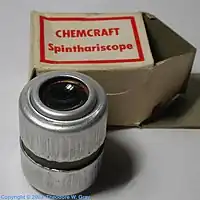
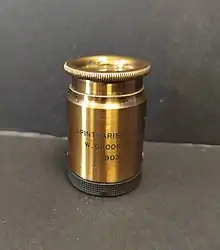
A spinthariscope (/spɪnˈθærɪskoʊp/)[2][3] is a device for observing individual nuclear disintegrations caused by the interaction of ionizing radiation with a phosphor (see radioluminescence) or scintillator.
Invention
The spinthariscope was invented by William Crookes in 1903.[4][5] While observing the apparently uniform fluorescence on a zinc sulfide screen created by the radioactive emissions (mostly alpha radiation) of a sample of radium bromide, he spilled some of the sample, and, owing to its extreme rarity and cost, he was eager to find and recover it.[6] Upon inspecting the zinc sulfide screen under a microscope, he noticed separate flashes of light created by individual alpha particle collisions with the screen. Crookes took his discovery a step further and invented a device specifically intended to view these scintillations. It consisted of a small screen coated with zinc sulfide affixed to the end of a tube, with a tiny amount of radium salt suspended a short distance from the screen and a lens on the other end of the tube for viewing the screen. Crookes named his device from Ancient Greek: σπινθήρ (spinthḗr) "spark".
Crookes debuted the spinthariscope at a meeting of the Royal Society, London on 15 May 1903.[7]
Toy spinthariscopes
Spinthariscopes were quickly replaced with more accurate and quantitative devices for measuring radiation in scientific experiments, but enjoyed a modest revival in the mid 20th century as children's educational toys.[8] In 1947, Kix cereal offered a Lone Ranger atomic bomb ring that contained a small one, in exchange for a box top and US$0.15 (equivalent to $1.97 in 2022).[9][10][11] Spinthariscopes can still be bought today as instructional novelties, but they now use americium or thorium. Looking into a properly focused toy spinthariscope, one can see many flashes of light spread randomly across the screen. Almost all are circular, with a very bright pinpoint centre surrounded by a dimmer circle of emission.
In museums
The American History Museum of the Smithsonian has several spinthariscopes in its collections, and an article discussing them.[12] However, as of 2022 none are currently on display.[13]
References
- ↑ AXIOCOM.be. "Le spinthariscope, un petit objet à l'histoire étonnante !". MUMONS (in French). Retrieved 2022-01-15.
- ↑ "spinthariscope". Merriam-Webster.com Dictionary. Retrieved 2022-01-18.
- ↑ Wells, John C. (2008). Longman Pronunciation Dictionary (3rd ed.). Longman. ISBN 978-1-4058-8118-0.
- ↑ Crookes, William (1903). "Certain Properties of the Emanations of Radium". Chemical News. 87 (2269): 241.
- ↑ Frame, Paul W. "The Crookes Spinthariscope". Oak Ridge Associated Universities. Retrieved 2 May 2013.
- ↑ Alfred Romer (1960). The Restless Atom: The Awakening of Nuclear Physics. Anchor Books. Retrieved 2 May 2013.
- ↑ Santos, Lucy Jane (2020). Half Lives: The Unlikely History of Radium. London: Icon Books Ltd. ISBN 978-1-78578-608-2. OCLC 1158229829.
- ↑ Bonnier Corporation (June 2007). "Popular Science". The Popular Science Monthly. Bonnier Corporation: 86–. ISSN 0161-7370. Retrieved 2 May 2013.
- ↑ Reif, Rita. "ARTS/ARTIFACTS; Trivia Long Ago, Serious Treasures Now". The New York Times. 11 June 1995.
- ↑ Miklós, Vincze (15 January 2014). "The Terrifying Age of Radioactive Toys for Kids" – via Gizmodo.
- ↑ "Lone Ranger Atom Bomb Ring Spinthariscope (1947 - early 1950s)". 5 October 2011 – via Oak Ridge Associated Universities.
- ↑ "The Spinthariscope and the Smithsonian".
- ↑ "Collections Search Results".
External links
- Modern spinthariscope
- Elements of electricity: a practical discussion of the fundamental laws and ... by Robert Andrews Millikan, Edwin Sherwood Bishop, American Technical Society