- The painting which inspired this piece of music is also sometimes called the Sposalizio; for it, see Sposalizio (painting).
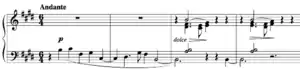
Sposalizio is the title of the first piece in Franz Liszt's Deuxième Année de Pèlerinage: Italie (Second Year of Pilgrimage: Italy), published in 1858. The composition starts out with a simple pentatonic melody, described as a "bell-like motif",[1] which transforms itself into a complex musical architecture. The melody then transforms itself into a type of wedding march, which continually embellishes itself to lead up to the grand climax, which contains crashing octaves into a loud finish. The composition ends quietly.
Liszt composed "Sposalizio", which translates as "Marriage", from Italian, after being inspired by Raphael's painting The Marriage of the Virgin.[2] Most of the works contained in the Italy series of Années de Pèlerinage have titles derived from works of art with a connection to Italy.[3]
Although the fast octaves can be somewhat challenging, the piece departs from the virtuosic fireworks that were trademarks of some of his earlier works.
References
- ↑ Percival Price, Charles Bodman Rae, James Blades (2001). Bell (i) (Fr. Cloche; Ger. Glocke; It., Sp. campana). In Grove Music Online (Oxford University Press) doi:10.1093/gmo/9781561592630.article.42837
- ↑ Jörg Jewanski (2014) [2001]. Colour and music. In Grove Music Online (Oxford University Press) doi:10.1093/gmo/9781561592630.article.06156
- ↑ Dolores Pesce, Maria Eckhardt, Rena Charnin Mueller (24 April 2023) [2001]. Liszt, Franz [Ferenc]. In Grove Music Online (Oxford University Press) doi:10.1093/gmo/9781561592630.article.48265