The following is a timeline of the history of the city of Pskov, Russia.
Prior to 20th century
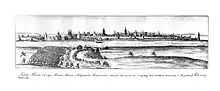
Pskov in 1661
| History of Russia |
|---|
 |
 Russia portal Russia portal |
- 903 - Pleskov founded.[1]
- 1156 - Mirozhsky Monastery established.[2]
- 1168 - Plotnitskii borough created.[3]
- 1212 - Partially burned by an Estonian raid under Lembitu.[4]
- 1240 - City captured by the Livonian Brothers of the Sword.[5]
- 1266 - City wall constructed by Daumantas of Pskov.[2]
- 14th C. Joined the Hanseatic League.[2]
- 1348 - City becomes independent from the Novgorod Republic per Treaty of Bolotovo.
- 1473 - Cave Church of the Dormition of the Theotokos built.
- 1510 - City taken by forces of Basil Ivanovich of the Grand Duchy of Moscow.[2][6]
- 1540 - Church of St. Peter and St. Paul, Pskov built (approximate date).
- 1579 - Execution of Ivo Schenkenberg, commander of an Estonian partisan unit, which fought against Russia in the Livonian War.[5]
- 1581 - August: Siege of Pskov begins.[2]
- 1582 - February: Siege of Pskov ends.[2]
- 1615 - City besieged by Swedish forces.[2][5]
- 1650 - Pskov Uprising of 1650.[6]
- 1699 - Trinity Cathedral rebuilt and consecrated.[2]
- 1843 - Catholic church built.[7]
- 1889 - Riga Bridge (Velikaya River) opens.
- 1897 - Population: 29,555.
- 1898 - Bridge built to Zapskovye quarter.[8]
20th century
- 1903 - Archaeological museum active.[2]
- 1911 - Olginsky Bridge opens.
- 1913 - Population: 38,300.[9]
- 1917 - March: Tsar Nicholas II abdicates while in Pskov.[1]
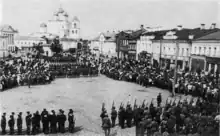
Estonian army parade in 1919
- 1919
- 25–26 May: Estonian War of Independence – city captured by Estonians.[5]
- 24 August: Withdrawal of Estonian forces.[5]
- Soviet Russia in power.
- 1920 - Pskov State Theatre active.
- 1930's - Pskov Airport founded.
- 1939 - Population: 59,898.[1]
- 1940 - June: Soviet 8th Army invaded Estonia and Latvia from the city.[10]
- 1941
- 1942
- February: Forced labour camp for Jewish men and women established by the Germans.[13]
- Stalag 372 prisoner-of-war camp established by the Germans.[14]
- 1943
- 1944
- 1958 - Pskov Electric Machine-Building Plant active.[16]
- 1959 - Population: 80,448.
- 1960 - Pskov State Polytechnic Institute established.
- 1965 - Population: 108,000.[17]
- 1967 - Bridge of the 50th Anniversary of October opens.
- 1985 - Population: 194,000.[18]
- 1989 - Population: 203,789.
- 1990 - Alexander Nevsky Bridge, Pskov opens.
- 1991 - August: Soviets launched an attack on Tallinn, Estonia from Pskov during the 1991 Soviet coup d'état attempt.[5]
- 1996 - Yevgeny Mikhailov elected governor of the Pskov Oblast.[19]
- 2000
- Mikhail Khoronen elected mayor.[20]
- Catholic cathedral construction begins.[7]
- City becomes part of the North Western Federal District.
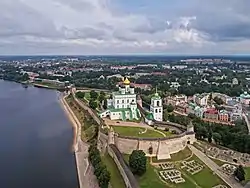
Aerial view of the city center in 2018
21st century
- 2009 - Ivan Tsetsersky becomes mayor.
- 2010 - Population: 203,279.
- 2010 - Established Pskov State University.
See also
- Pskov history
- History of Pskov
- Other names of Pskov, e.g. Pleskau, Pleskov
- Timelines of other cities in the Northwestern Federal District of Russia: Kaliningrad, St. Petersburg
References
- 1 2 3 4 5 Leon E. Seltzer, ed. (1952), "Pskov", Columbia Lippincott Gazetteer of the World, New York: Columbia University Press, p. 1525, OL 6112221M
- 1 2 3 4 5 6 7 8 9 Britannica 1910.
- ↑ Langer 1984.
- ↑ Henry of Latvia, Heinrici Cronicon Lyvoniae, p. 131
- 1 2 3 4 5 6 7 8 ""Pihkva pole enam kaugel!"". Eesti Ekspress (in Estonian). Retrieved 9 August 2022.
- 1 2 Lawrence N. Langer (2002). "Chronology". Historical Dictionary of Medieval Russia. Scarecrow Press. ISBN 978-0-8108-6618-8.
- 1 2 "New Russian Cathedral Stymied by Interfaith Rift", New York Times, 10 September 2002
- ↑ Baedeker 1914.
- ↑ "Russia: Principal Towns: European Russia". Statesman's Year-Book. London: Macmillan and Co. 1921. hdl:2027/njp.32101072368440.
- ↑ Eestlased vene sõjaväes 1940–1945. Raamat 12 (in Estonian and English). Tallinn: Estonian Repressed Persons Records Bureau. 2016. p. 33. ISBN 978-9985-9914-5-9.
- ↑ Daniela Kalkandjieva (2015). The Russian Orthodox Church, 1917-1948: From Decline to Resurrection. Routledge. ISBN 978-1-317-65776-7.
- ↑ "German Dulag Camps". Retrieved 9 August 2022.
- 1 2 "Zwangsarbeitslager für Juden Pleskau". Bundesarchiv.de (in German). Retrieved 9 August 2022.
- 1 2 "German Stalag Camps". Retrieved 9 August 2022.
- ↑ "Arbeitserziehungslager Pleskau". Bundesarchiv.de (in German). Retrieved 9 August 2022.
- ↑ Eastern Europe, Russia and Central Asia 2003. Europa Publications. 2002. ISBN 978-1-85743-137-7.
- ↑ "Population of capital cities and cities of 100,000 and more inhabitants". Demographic Yearbook 1965. New York: Statistical Office of the United Nations. 1966.
- ↑ United Nations Department of Economic and Social Affairs, Statistical Office (1987). "Population of capital cities and cities of 100,000 and more inhabitants". 1985 Demographic Yearbook. New York. pp. 247–289.
{{cite book}}: CS1 maint: location missing publisher (link) - ↑ Robert A. Saunders; Vlad Strukov (2010). Historical Dictionary of the Russian Federation. Scarecrow Press. ISBN 978-0-8108-7460-2.
- ↑ Robert W. Orttung, ed. (2000). Republics and Regions of the Russian Federation: A Guide to Politics, Policies, and Leaders. M.E. Sharpe. ISBN 978-0-7656-0559-7.
This article incorporates information from the Russian Wikipedia.
Bibliography
- Abraham Rees (1819), "Pskov", The Cyclopaedia, London: Longman, Hurst, Rees, Orme & Brown, hdl:2027/mdp.39015057241096 – via HathiTrust
- George Ripley; Charles A. Dana, eds. (1879). "Pskov". American Cyclopedia (2nd ed.). New York: D. Appleton and Company. hdl:2027/hvd.hn585k.
- "Pskof", Hand-book for Travellers in Russia, Poland, and Finland (4th ed.), London: J. Murray, 1888
- Kropotkin, Peter Alexeivitch; Bealby, John Thomas (1910). . Encyclopædia Britannica. Vol. 22 (11th ed.). pp. 542–543.
- "Pskov", Russia, Leipzig: Karl Baedeker, 1914, OCLC 1328163
- William Henry Beable (1919), "Pskov", Russian Gazetteer and Guide, London: Russian Outlook
- Lawrence N. Langer (1984). "The Posadnichestvo of Pskov: Some Aspects of Urban Administration in Medieval Russia". Slavic Review. 43 (1): 46–62. doi:10.2307/2498734. JSTOR 2498734. S2CID 156372600.
- Timothy E. Heleniak (1988). "Russian Soviet Federative Socialist Republic: Northwest Region: Pskov Oblast and City". Bibliography of Soviet Statistical Handbooks. Washington DC: U.S. Bureau of the Census. hdl:2027/uva.x001867410 – via Hathi Trust. (fulltext)
- Trudy Ring, ed. (1995). "Pskov". International Dictionary of Historic Places: Northern Europe. Fitzroy Dearborn. p. 610. ISBN 978-1-136-63944-9.
- Savignac, David (trans). The Pskov 3rd Chronicle.
External links

Wikimedia Commons has media related to Pskov.
This article is issued from Wikipedia. The text is licensed under Creative Commons - Attribution - Sharealike. Additional terms may apply for the media files.