| "Trampled Under Foot" | ||||
|---|---|---|---|---|
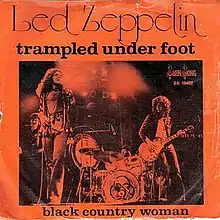 Netherlands single picture sleeve | ||||
| Single by Led Zeppelin | ||||
| from the album Physical Graffiti | ||||
| B-side | "Black Country Woman" | |||
| Released | 2 April 1975 (US) | |||
| Recorded | January–February 1974 | |||
| Studio |
| |||
| Genre | ||||
| Length | 5:38 | |||
| Label | Swan Song | |||
| Songwriter(s) | ||||
| Producer(s) | Jimmy Page | |||
| Led Zeppelin singles chronology | ||||
| ||||
| Audio sample | ||||
| ||||
"Trampled Under Foot" is a song by English rock group Led Zeppelin. A funk-influenced piece with John Paul Jones on clavinet, it was included on their 1975 album Physical Graffiti. The song was released as a single in several countries and was frequently performed in concert.
Lyrics
The lyrics were inspired by blues musician Robert Johnson's 1936 song "Terraplane Blues".[6] A Terraplane is a classic car, and the song uses car parts as metaphors for sex—"pump your gas", "rev all night", etc. The themes of these songs however differ; "Terraplane Blues" is about infidelity, while "Trampled Under Foot" is about giving in to sexual temptation.[7]
Composition and recording
The song evolved out of a jam session in 1972 and is credited to Robert Plant, Jimmy Page and John Paul Jones.[8] Much rehearsal went into perfecting the relentless semi-funk riff that dominates this song.[6] John Paul Jones has credited Stevie Wonder with the inspiration for the beat ("Superstition", 1972), which he played on a clavinet.[6][9] Page played through a wah-wah pedal and, as producer, employed reverse echo on the recording.[6][10]
Reception and charts
Billboard described "Trampled Under Foot" as "the most commercial single [Led Zeppelin] put together in several years" and as having "a powerful staccatto beat."[11] Cash Box called it a "high-powered effort" that "packs a punch that is sure to be felt on top of the charts."[12] Record World said that "As Zeppelin-sanity begins to reach Beatlemaniacal proportions, the stage is set for the heavy metalmen to take their first single from Physical Graffiti to the top."[13] Released in April 1975, it reached number 38 on the Billboard Hot 100.[14]
| Chart (1975) | Peak position |
|---|---|
| Australia (Kent Music Report)[15] | 60 |
| Canada Top Singles (RPM)[16] | 41 |
| US Billboard Hot 100[14] | 38 |
| US Cash Box[17] | 28 |
| US Record World[18] | 39 |
Live performances and other versions
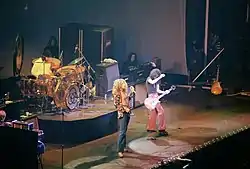
"Trampled Under Foot" became a standard part of Led Zeppelin concerts from 1975 onwards, being played on every tour until 1980.[6] In 2012, the song was performed during the London Olympics opening ceremony as a part of a selected playlist.[19]
A rough mix of the track with less overdubbing was titled "'Brandy & Coke' (Trampled Under Foot) [Initial Rough Mix]". It was released on 11 February 2015 (on iTunes), as part of the remastering process of all nine albums.[20] The rest of the album was released on 23 February 2015.
Personnel
According to Jean-Michel Guesdon and Philippe Margotin:[21]
- Robert Plant – vocals
- Jimmy Page – electric guitars
- John Paul Jones – bass, Clavinet
- John Bonham – drums
See also
References
- ↑ Schuman, Michael A. (2009). Led Zeppelin: Legendary Rock Band. Enslow Publishers. ISBN 978-0-7660-3026-8.
The keyboard-driven, hard rock track "Trampled Under Foot" was popular on FM stations.
- ↑ Schinder, Scott; Schwartz, Andy (2008). Icons of Rock: An Encyclopedia of the Legends Who Changed Music Forever. Vol. 2. Greenwood Publishing Group. ISBN 978-0-313-33847-2.
"Houses of the Holy" and "Trampled Under Foot" were tightly constructed, even danceable hard rock tunes.
- ↑ Hunter-Tilney, Ludovic. "Led Zeppelin, O2 Arena, London". Financial Times. Archived from the original on 7 May 2015. Retrieved 14 July 2013.
- ↑ Elliott, Paul (30 May 2016). "The Top 20 Greatest Funk Rock Songs". TeamRock. Archived from the original on 2 June 2016. Retrieved 20 September 2021.
- ↑ Chick, Stevie (2005). "Led Zeppelin - Physical Graffiti". In Dimery, Robert (ed.). 1001 Albums You Must Hear Before You Die. London: Cassell Illustrated. p. 338.
- 1 2 3 4 5 Lewis, Dave (1994). The Complete Guide to the Music of Led Zeppelin. Omnibus Press. ISBN 0-7119-3528-9.
- ↑ Godwin, Robert (24 August 1990). "Led Zeppelin: Alchemists of the '70s". Goldmine. p. 13.
- ↑ Godwin, Robert (2003). "Led Zeppelin: The Press Reports". Collector's Guide Publishing. p. 321. ISBN 1-896522-41-6.
- ↑ Snow, Mat (December 2007). "The Secret Life of a Superstar". Mojo. p. 13.
- ↑ Rosen, Steven (25 May 2007). "1977 Jimmy Page Interview (Audio/Text)". Modern Guitars. Archived from the original on 5 January 2011.
- ↑ "Billboard's Top Single Picks" (PDF). Billboard. 12 April 1975. p. 86. Retrieved 17 July 2020.
- ↑ "Singles Reviews" (PDF). Cash Box. Vol. XXXVI, no. 47. 12 April 1975. p. 22. Retrieved 11 December 2021.
- ↑ "Hits of the Week" (PDF). Record World. 12 April 1975. p. 1. Retrieved 10 March 2023.
- 1 2 "Led Zeppelin – Awards". AllMusic. Retrieved 14 July 2013.
- ↑ "Forum – ARIA Charts: Special Occasion Charts – CHART POSITIONS PRE 1989". Australian-charts.com. Hung Medien. Retrieved 30 July 2013.
- ↑ "Top RPM Singles: Issue 3969a." RPM. Library and Archives Canada. Retrieved 30 July 2013.
- ↑ "CASH BOX Top 100 Singles – Week ending MAY 31, 1975". Cash Box. Archived from the original on 3 October 2012.
- ↑ "The Singles Chart" (PDF). Record World. 17 May 1975. p. 31. ISSN 0034-1622. Retrieved 17 September 2017.
- ↑ Heath, Sophia (19 June 2012). "London 2012 Olympics: the full musical playlist for the Olympic opening ceremony". The Daily Telegraph. Retrieved 30 July 2013.
- ↑ Grow, Kory (8 January 2015). "Led Zeppelin Announce Super-Deluxe 'Physical Graffiti' Reissue". Rolling Stone. Retrieved 12 January 2015.
- ↑ Guesdon & Margotin 2018, p. 388.
Bibliography
- Guesdon, Jean-Michel; Margotin, Philippe (2018). Led Zeppelin All the Songs: The Story Behind Every Track. Running Press. ISBN 978-0-316-448-67-3.

