| Trillium maculatum | |
|---|---|
 | |
Scientific classification  | |
| Kingdom: | Plantae |
| Clade: | Tracheophytes |
| Clade: | Angiosperms |
| Clade: | Monocots |
| Order: | Liliales |
| Family: | Melanthiaceae |
| Genus: | Trillium |
| Species: | T. maculatum |
| Binomial name | |
| Trillium maculatum | |
| Synonyms[3] | |
|
Trillium maculatum
| |

Trillium maculatum, the spotted wakerobin or spotted trillium,[4][5] is a species of flowering plant in the family Melanthiaceae. It is a member of the Trillium cuneatum complex, a closely related group of sessile-flowered trilliums. The species is endemic to the southeastern United States, ranging across Alabama, Georgia, South Carolina, and northern Florida.
Description
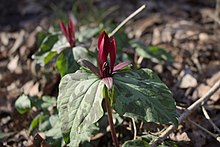
Trillium maculatum is a perennial, herbaceous, flowering plant that persists by means of an underground rhizome. Like all trilliums, it has a whorl of three bracts (leaves) and a single trimerous flower with three sepals, three petals, two whorls of three stamens each, and three carpels (fused into a single ovary with three stigmas).[6] It has a sessile flower (no flower stalk), erect petals, and mottled leaves.[7] Its flower petals are deep red or reddish-purple but occasionally yellow.[5]
Taxonomy
Trillium maculatum was first described by Constantine Samuel Rafinesque in 1830.[2] The specific epithet maculatum means "spotted",[8] a reference to the conspicuously marked leaves of some forms of this species.[9] Although Rafinesque described a species with spotted stems,[10] later authors have not confirmed that character.
Trillium maculatum is a member of the Trillium cuneatum complex, a group of eight taxa including Trillium luteum and Trillium cuneatum (in the strict sense).[11] All members of the complex are sessile-flowered trilliums (Trillium subgen. Sessilia).
Distribution and habitat
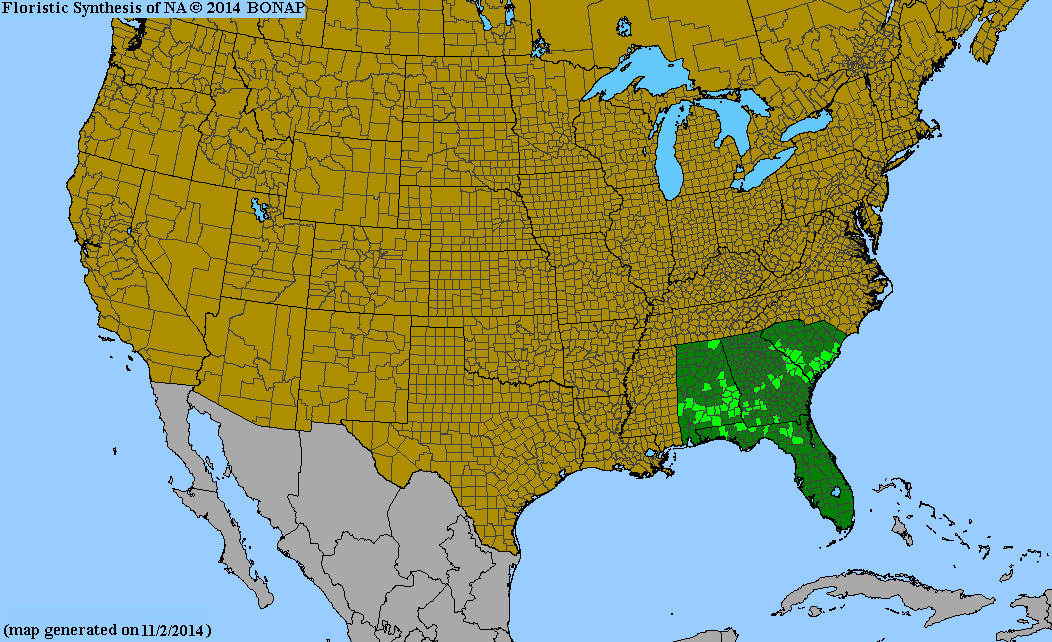
Trillium maculatum is endemic to the southeastern United States, ranging across South Carolina, Georgia, Alabama, and northern Florida.[3][12]
Ecology
Trillium maculatum flowers early February to early April.[13]
References
- ↑ "Trillium maculatum". NatureServe Explorer. NatureServe, Arlington, Virginia. Retrieved 31 March 2023.
- 1 2 "Trillium maculatum Raf.". International Plant Names Index (IPNI). Royal Botanic Gardens, Kew; Harvard University Herbaria & Libraries; Australian National Botanic Gardens. Retrieved 31 March 2023.
- 1 2 "Trillium maculatum Raf.". Plants of the World Online. Royal Botanic Gardens, Kew. Retrieved 31 March 2023.
- ↑ USDA, NRCS (n.d.). "Trillium maculatum". The PLANTS Database (plants.usda.gov). Greensboro, North Carolina: National Plant Data Team. Retrieved 31 March 2023.
- 1 2 Case Jr., Frederick W. (2002). "Trillium maculatum". In Flora of North America Editorial Committee (ed.). Flora of North America North of Mexico (FNA). Vol. 26. New York and Oxford: Oxford University Press. Retrieved 31 March 2023 – via eFloras.org, Missouri Botanical Garden, St. Louis, MO & Harvard University Herbaria, Cambridge, MA.
- ↑ Case Jr., Frederick W. (2002). "Trillium". In Flora of North America Editorial Committee (ed.). Flora of North America North of Mexico (FNA). Vol. 26. New York and Oxford: Oxford University Press. Retrieved 29 March 2023 – via eFloras.org, Missouri Botanical Garden, St. Louis, MO & Harvard University Herbaria, Cambridge, MA.
- ↑ Case Jr., Frederick W. (2002). "Trillium subg. Phyllantherum". In Flora of North America Editorial Committee (ed.). Flora of North America North of Mexico (FNA). Vol. 26. New York and Oxford: Oxford University Press. Retrieved 29 March 2023 – via eFloras.org, Missouri Botanical Garden, St. Louis, MO & Harvard University Herbaria, Cambridge, MA.
- ↑ Gledhill, David (2008). The Names of Plants (4th ed.). Cambridge University Press. p. 247. ISBN 978-0-521-86645-3.
- ↑ Case & Case (1997), p. 209.
- ↑ Rafinesque, C. S. (1830). Medical Flora; or Manual of the Medical Botany of the United States of North America. Vol. 2. Philadelphia. p. 103. Retrieved 14 February 2022.
- ↑ Lampley (2021), Ch. 2.
- ↑ "Trillium maculatum". County-level distribution map from the North American Plant Atlas (NAPA). Biota of North America Program (BONAP). 2014. Retrieved 31 March 2023.
- ↑ Stritch, Larry. "Spotted Trillium (Trillium maculatum)". United States Forest Service. Retrieved 7 October 2019.
Bibliography
- Case, Frederick W.; Case, Roberta B. (1997). Trilliums. Portland, Oregon: Timber Press. ISBN 978-0-88192-374-2.
- Freeman, J. D. (1975). "Revision of Trillium subgenus Phyllantherum (Liliaceae)". Brittonia. 27 (1): 1–62. doi:10.2307/2805646. JSTOR 2805646. S2CID 20824379.
- Lampley, Jayne A. (2021). A systematic and biogeographic study of Trillium (Melanthiaceae) (PhD). University of Tennessee. Retrieved 31 March 2023.
External links
- Native Florida Wildflowers
- Wildflowers of the United States
- Atlas of Florida Vascular Plants
- Trillium maculatum in the CalPhotos photo database, University of California, Berkeley
- Citizen science observations for Trillium maculatum at iNaturalist
- Biodiversity Information Serving Our Nation (BISON) occurrence data and maps for Trillium maculatum